In November 2012 Jun Mizutani, then Japan's leading male player, gave an interview to the sports magazine Number that read like a charge sheet. "The International Table Tennis Federation clearly prohibits the use of boosters," he said (translated from Japanese). "In other words, a rubber with booster rubbed into it is an 'illegal rubber'." Then came the part that made headlines: "But in countries other than Japan, there are many players competing in international events using this illegal rubber." Mizutani described opponents' shots coming back "with speed and spin unthinkable from the performance of an ITTF-approved rubber", and "a sound like striking metal" echoing around the hall, words also reported by J-CAST, which wrote that he would not play in world events until the problem was dealt with.
Nearly nine years later Mizutani won Olympic gold in the mixed doubles at Tokyo 2020 with Mima Ito. The thing he had complained about, known in table tennis as boosting, has been the sport's open secret for most of that time: widely discussed by players, banned in the rules, and very hard to prove. This is the story of how it began, why it is illegal, and how the authorities have spent more than a decade trying to catch it.
Start with the equipment, because boosting only makes sense once you know what a modern racket is. A table tennis bat is a wooden blade, sometimes with carbon or other fibres inside, covered on each side with a rubber. Most top players use inverted rubber: a sheet of grippy, smooth-faced rubber glued on top of a layer of sponge. The rubber grips the ball to make spin; the sponge compresses and springs back to add speed. Some players, such as the defenders who chop the ball back, use pimpled rubbers on one side instead. Every rubber used in a sanctioned competition must appear on the ITTF's List of Authorised Racket Coverings, and Law 2.4.7 of the ITTF's rules says simply: "The racket covering shall be used without any physical, chemical or other treatment." Boosting is the practice of breaking that rule after a rubber leaves the factory, by brushing oils or other liquids, sold as boosters or tuners, on to the sponge so that it swells and the rubber becomes livelier. As the ITTF's equipment manager Claudia Herweg put it in 2019, "Boostering is an after treatment of approved racket rubbers."
The sponge itself was once the scandal. At the 1952 World Championships in Bombay, the first held in Asia, Hiroji Satoh of Japan became, in the ITTF's words, "the first player to win a World Championship when using a racket covered with thick sponge". Using a thickly covered sponge racket, as Table Tennis England's archive puts it, "he mesmerised opponents". The ITTF's history records that the thick sponge bat caused "major controversies for the next several years". By 1959, as Table Tennis England's archive puts it, agreement had been reached on racket standardisation, with the elimination of thick sponge. Today's laws limit a sponge rubber to 4.0mm, adhesive included. Almost every later fight about equipment, from the 1983 rule requiring the two sides of the racket to be clearly different colours (narrowed to red and black two years later, and relaxed in 2021 to allow one side to be pink, purple, green or blue instead of red) to the arguments over boosters, has been a variation on the question Satoh's racket raised: how much of a shot belongs to the player, and how much to the equipment?
From speed glue to boosters
Boosting is the descendant of speed glue, which dominated the sport for 30 years. The European Table Tennis Hall of Fame says the Hungarian Tibor Klampár, world men's doubles champion in 1971 with István Jónyer, "will be remembered as a player who discovered the benefit of speed-gluing". The discovery, usually dated to the 1970s, was that re-gluing a rubber shortly before a match with a solvent-based glue made the sponge swell and the rubber play faster and spinnier. Speed glue soon became routine at the top of the game, and players re-glued their rubbers before matches.
The problem was what was in the glue. Volatile organic compounds, or VOCs, are solvents that evaporate easily, and inhaling them is bad for you. The ITTF decided in 2004 to ban glues containing them, then postponed the ban several times, according to a China Daily report in May 2007. A hospitalisation case earlier that year, the paper reported, pushed the federation into acting faster. "As an ITTF President, it's my responsibility to protect players' health," Adham Sharara, the ITTF's president, said. "One case is a big warning, a new case will be a disaster." Not everyone was grateful. "The ITTF have changed a lot of rules in recent years and they are making unpopular decisions," said Liu Guoliang, then China's head coach. The ITTF withdrew its approval of all existing glues, began testing rackets at junior events from 1 January 2008, and brought the ban into force at all its events from 1 September 2008, after the Beijing Olympics. Testers used handheld devices that detect solvent vapour, in effect electronic noses. The 2009 World Championships in Yokohama were the first in more than 30 years without speed glue. "There's no going back," Sharara said before them, in remarks reported by the Taipei Times.
- Xiom73coverings
- Dr Neubauer60coverings
- Andro58coverings
- Stiga57coverings
- Victas54coverings
- Donic45coverings
- Tibhar45coverings
- Butterfly44coverings
- Nittaku44coverings
- DHS39coverings
Eleven counted every covering with an ITTF approval code in the January 2026 List of Authorised Racket Coverings, using a machine-readable copy of the ITTF's published list (dated 23 January 2026): 1,365 coverings from 135 brands, of which the ten largest brands account for 38%. Older coverings listed without a code are not included.
Source: ITTF LARC, January 2026 (HTTV copy); LARC offline check data
Players did not stop wanting what speed glue gave them, and the industry and the players found two ways to get it back. The legal route was the factory-tuned rubber. Butterfly, the Japanese manufacturer, had launched what it calls "the world's first High Tension rubber" in 1997, and in 2008, the year of the glue ban, it brought out Tenergy 05, "the first Spring Sponge generation rubber". The German company Donic describes its own tension technology as "the method of permanently integrating the speed glue effect into table tennis rubbers". These rubbers are built at the factory to play the way glued rubbers used to, and they appear on the authorised list as made. Eleven counted the list as it stood in January 2026 and found 1,365 coverings with an ITTF approval code, from 135 brands. Some earlier coverings on the list carry no code, which is why the ITTF's own published totals are higher: more than 1,600 in 2019 and 1,667 in 2021. An earlier Eleven feature on table tennis tables found the same proliferation in the equipment the players play on.
The other route was the booster. Boosters are oils or liquids applied to the sponge before the rubber is glued on, and they do much of what speed glue did. Unlike glue solvents, many give off little or no vapour, so the devices built to sniff out VOCs do not detect them. Mizutani made exactly that point in 2013. "The testing machine for illegal solvents is a machine that detects smell, but 'boosters' are almost odourless and can't be detected," he told Gendai (translated from Japanese). "In other words, under the current testing regime, violations cannot be policed." Sharara had acknowledged the shift the year before. "Now players have started to find other elements to put on the racket that will give the same effect," he told the Associated Press in August 2012.
How common is it?
- Players at the event (approx.)170
- Rackets checked70
- Rackets dismantled31
- Rubbers outside the guidelines6
Eleven took the four figures the ITTF published and compared them: the six failures were 9% of the rackets checked and 19% of those dismantled. The sample was small and not random, so neither share measures boosting across the circuit.
Source: ITTF, 27 May 2019
The most prominent European voice was Timo Boll. In February 2016 the German, a former world No 1, told the Frankfurter Allgemeine Zeitung, in words translated by Shanghai Daily: "About 80 percent of the international players are playing with rackets which do not conform to the rules of the ITTF. The rubbers are treated with chemicals to increase the catapult effect when hitting." He added: "This applies not only for the Chinese players, but for Europeans and other Asians too." The ITTF's then president, Thomas Weikert, replied: "I am confident that our testing procedures are doing the job to prevent boosting." In China, the former world champion Wang Liqin answered Boll in the Shanghai newspaper Wenhui Daily, arguing that the decisive factor in table tennis is the player rather than the equipment. Boll returned to the subject in 2017. "In a match I notice immediately when someone is playing with a manipulated racket," he told the news agency SID (translated from German). "Some ball trajectories are not even possible without such rubbers."
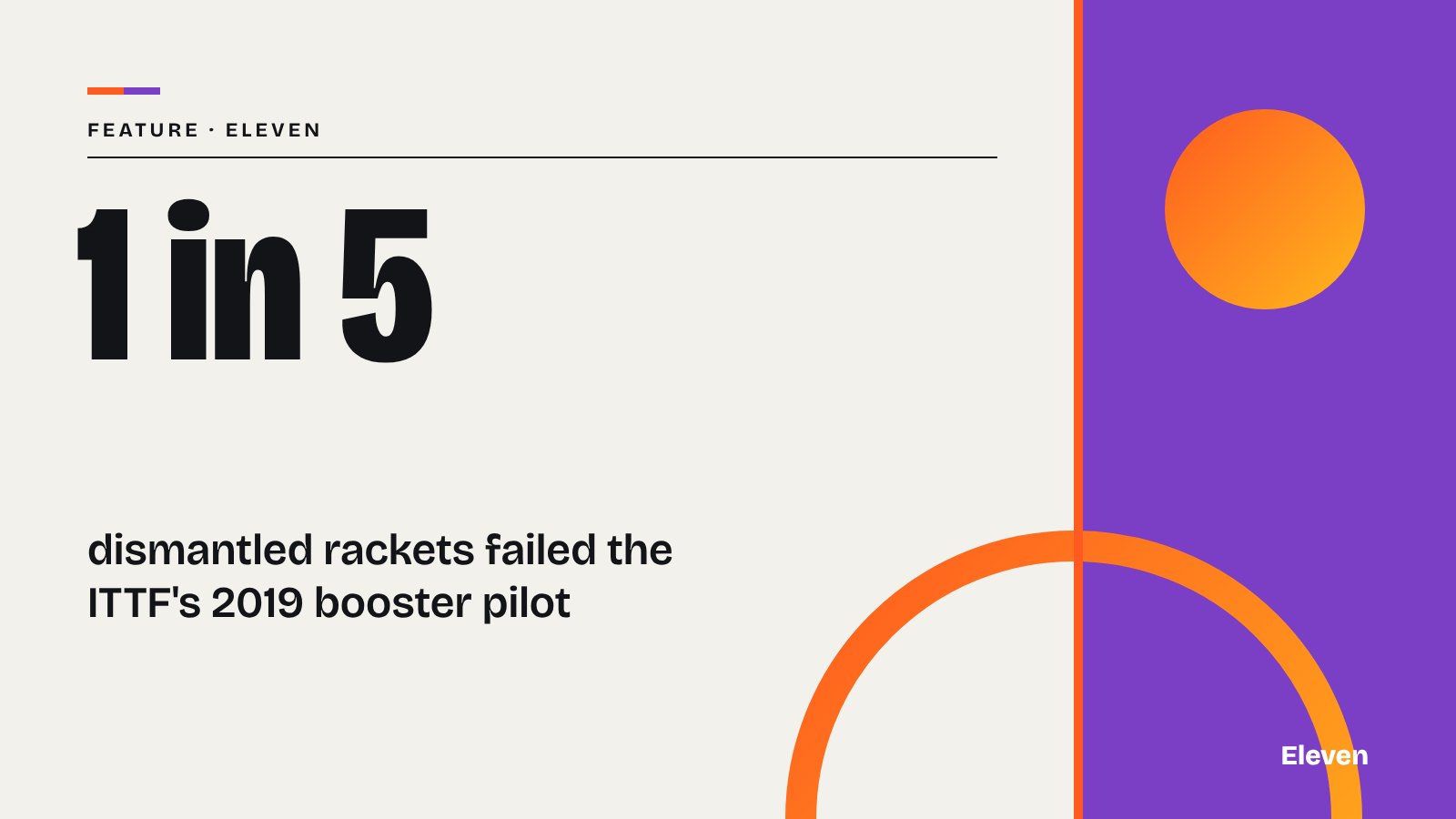
Boll's 80% was his estimate, and no one has published a figure to test it against. The closest thing is a pilot the ITTF ran in 2019 at the Croatia Open in Zagreb, with a German institute using gas chromatography, a laboratory technique that separates a sample into its chemical components. Herweg described the results to the ITTF's website. "From approximately 170 participants, we have checked 70 rackets, of which 31 were dismantled, mostly only one side," she said. "Of these 31 rackets, 6 rubbers fell outside our guidelines, which is around 20%." The players faced no consequences; it was a trial. Herweg gave three reasons for keeping the ban: health, the development of the sport, and fairness.
Eleven set those figures side by side. Six failures among 70 rackets checked is about one in 12; among the 31 that were taken apart, closer to one in five. Neither figure measures how widespread boosting was across the circuit, because the sample was small and the event was a lower-tier one. What the pilot did show was that a test needed to see inside the racket. A booster that cannot be smelled can still leave traces: a sponge that has swollen beyond its manufactured thickness, a rubber that no longer lies flat, chemical residues that a laboratory can find.
Checking rackets
Racket control has moved in that direction since. The ITTF's technical leaflet on racket control now sets measurable limits that an official can check at the table: an average thickness under 4.05mm for a sponge rubber, which is the 4.0mm law plus a tolerance of 0.05mm for the measuring device; a tight tolerance for flatness; and a limit on solvent vapour. Penalties can include fines of up to 10,000 Swiss francs, the loss of results and suspensions of up to a year. In February 2024, at its council meeting in Busan, the ITTF voted 32 to eight to allow rubbers to be removed from the blade and inspected after matches, a proposal whose rationale said the procedure "could detect the suspicious cheating of the over-thick racket coverings".
The same month in Busan showed what the thickness limit means in practice. At the World Team Championships, a match played by the American Jishan Liang was awarded to his opponent as a walkover "due to Jishan's racket being too thick", USA Table Tennis reported, and the ITTF jury declined the team's appeal. The tie went from 2-2 to a 3-1 defeat. Nothing in the case showed that a booster had been used, and thickness can have other causes, but it showed that the measurement had consequences.
In January 2025 the ITTF announced the full procedure. Post-match inspections, it said, "will be conducted immediately after matches". "With the referee's permission and the player's presence, the racket covering will be removed" so that blade and rubber can be checked separately. The system had been trialled at the Asian and European Championships in October 2024, where comprehensive inspections were carried out from the quarter-finals onwards, and is being rolled out progressively from 2025. For newer fans watching the leading players on the world rankings at a WTT event, the result is visible only in passing: a player handing a racket to an official at the end of a match, and getting it back later, in pieces.
The history suggests why this has taken so long. Speed glue took four years from the decision to ban it to enforcement, and that was a substance anyone could smell. Boosting asks officials to prove that something was done to a rubber after it left the factory, using a product designed to leave no trace, and to do it to the satisfaction of a jury that can overturn a result. Mizutani's complaint in Number came about 12 years before the dismantling procedure began.
Mizutani, interviewed in 2012, had pointed to one detail that anyone in the hall could notice: the sound. He described shots that rang out like metal. The sport's long argument about equipment, since Satoh's silent sponge in 1952, has always been as much about what spectators hear and players feel as about what officials can measure. Since 2025, officials have had a way to measure it too: they take the racket apart.


