Japan and China were level at 2-2 in the women's team final of the Asian Championships in Tashkent on 22 October when the deciding match fell to Honoka Hashimoto. Across the table was Wang Yidi, the world No 4. Hashimoto, one of table tennis's few remaining choppers, won the first two games, lost the third and closed out the fourth 11-7. Japan had beaten China 3-2.
She had opened the final too, beating Chen Yi 3-0. In between, Wang Yidi beat Miwa Harimoto in five games and Kuai Man beat Hina Hayata 3-0 to put China ahead, before Harimoto levelled by beating Chen Yi. Two of Japan's three points came from a player whose game is built on backspin, patience and the other player's mistakes, against a Chinese team with three of the world's top 10.
Hashimoto, now ranked 14th, is not the only defender doing damage this season. Her teammate Hitomi Sato is No 8 in the world and reached her first Grand Smash final in Beijing this month. Germany's Han Ying is No 16 at 43. Three of the women's top 20 are defenders.
Hashimoto is 28 and comes from Aichi. She won three WTT Contender titles in 2025, in Taiyuan, Lagos and Almaty, and reached a career-high No 10 a year ago. Sato, also 28 and from Hakodate on Hokkaido, has been a fixture on the tour for a decade; in 2016 the ITTF credited her defensive skills with eight under-21 titles on the World Tour.
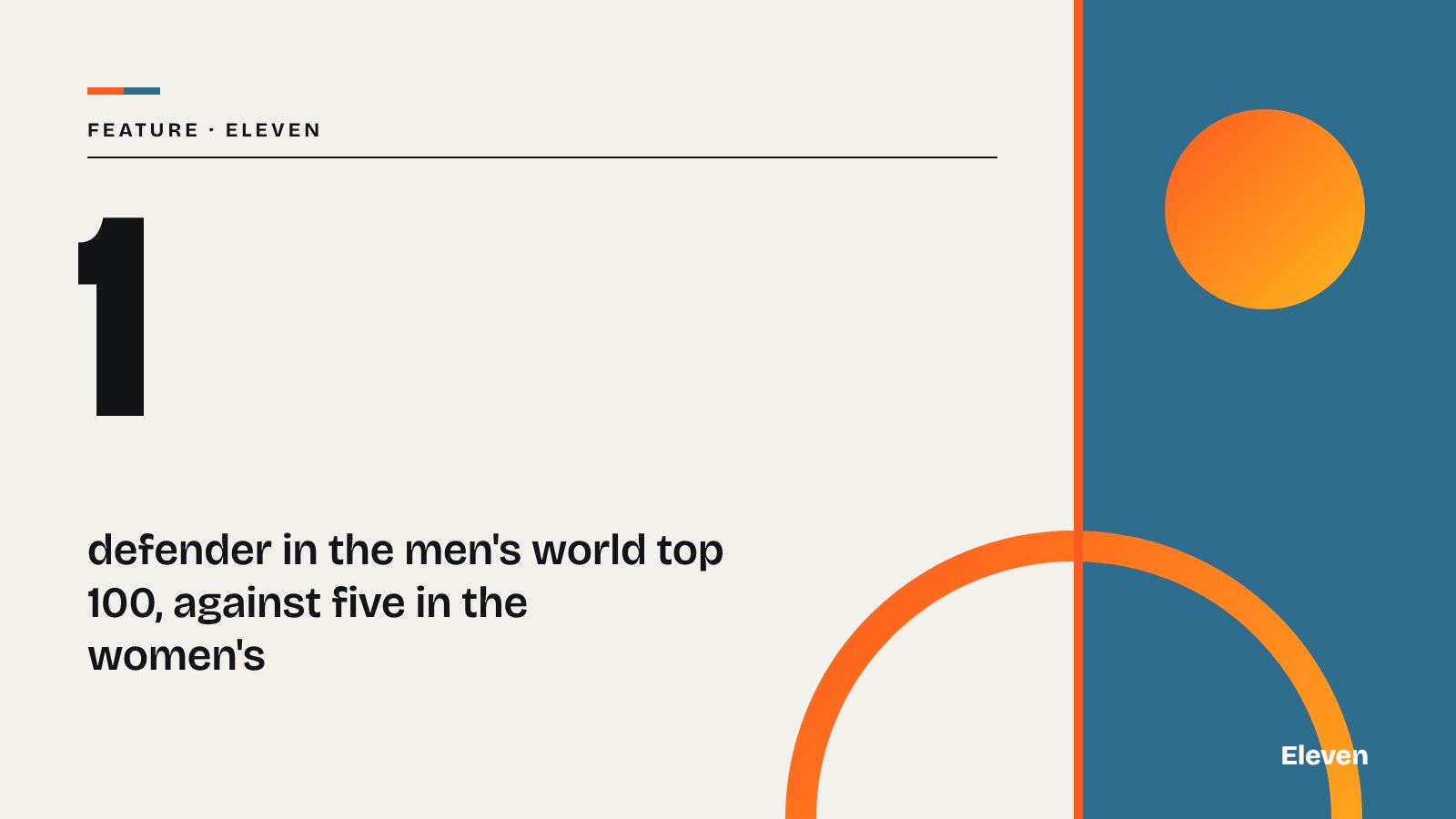
In the men's game the style has almost disappeared. Eleven went through the world ranking of 26 October and counted the defensive players in the top 100. There are five among the women: Sato, Hashimoto and Han, plus Sweden's Linda Bergström at No 78 and the Netherlands' Li Jie at No 100. Among the men there is one, Slovakia's Wang Yang, at No 88. No man in the top 87 plays this way.
- Women, top 101
- Women, top 203
- Women, top 1005
- Men, top 100
- Men, top 200
- Men, top 1001
Eleven checked every player in the men's and women's top 100 of the ITTF world ranking of 26 October 2026 against Tabletennis Reference's list of cut-type players and counted only those whom a second source (a federation, event organiser, broadcaster or Wikipedia) also calls a defender or chopper. Sabine Winter, an attacker who uses anti-spin rubber on her backhand, is not counted.
Source: ITTF world ranking, week 44; Tabletennis Reference; Top 16 Montreux; NOS; ETTU; TV Tokyo; Wikipedia
The men's list thins out even further below that. Tabletennis Reference, an equipment and results site that records each top player's style, lists only three more male defenders inside the top 200: South Korea's Kang Dongsoo, Greece's Panagiotis Gionis and Japan's Satoshi Aida.
What a defender does
A defender, or chopper, works from well behind the table and answers the attacker's topspin with heavy backspin, sliced down and under the ball. Every return asks the attacker to lift a low, spinning ball and hit it again. The best defenders mix in balls carrying little spin, which look the same and sit up, and they attack themselves when the chance comes.
Sato showed what the style can still do at the United States Smash in Los Angeles in June. Given a wildcard and ranked 21st, she beat Wang Manyu, then the world No 2, 12-10, 11-4, 15-13 in the second round. Butterfly's report called her "a Japanese modern defender" and made her the story of the day (Butterfly). She beat Hashimoto in the next round and led Kuai Man 3-1 in the quarter-final before losing the seventh game 18-16.
She had done her homework. In January, at WTT Champions Doha, Han had beaten Wang 4-3 in the quarter-final, taking the seventh game 11-6, and at 42 years and 256 days became the oldest player to reach a WTT Champions semi-final. "I am extremely pleased with my performance because I have never beaten her before," Han said, as reported by the Gulf Times.
Han was born in Shenyang and switched to chopping at her father's urging. She became a German citizen in 2010, won Olympic team silver for Germany at Rio 2016 and reached a career-high No 6 in February 2017. Nine years later she is still in the top 20.
Sato had studied that match. "Han Ying was not afraid of being hit; on the contrary, she made moves as if inviting her to hit," she said after the Los Angeles win, in comments reported by SPREAD (translated from Japanese). She had set out to copy it.
A long tradition
The style is as old as the international game. Richard Bergmann, who won the world singles title for Austria in 1937 and for England in 1939, 1948 and 1950, was noted for his defence, according to the European Table Tennis Hall of Fame. In the era of the smaller celluloid ball and 21-point games, defence was a route to the very top.
Women's defenders reached the summit as well. In 1981 in Novi Sad, China's Tong Ling won the women's world singles title as a defender. Since then, the writer Ian Marshall noted in 2010, the attacking player has dominated.
China, the country that made attacking table tennis its own, kept defenders in its strongest teams. Chen Xinhua won the World Cup in 1985 and from 1990 represented England. At the 1995 World Championships in Tianjin, with the men's team final against Sweden level at 1-1, the chopper Ding Song beat Peter Karlsson 21-14, 21-11, and China went on to win 3-2.
- Men, November 20101
- Men, February 20160
- Men, October 20260
- Women, November 20101
- Women, February 20162
- Women, October 20261
Eleven took the top 10 of the ITTF world ranking at three dates and counted the defenders: Joo Se-hyuk (men, 2010), Kim Kyung-ah (women, 2010), Han Ying and Wu Yang (women, 2016) and Hitomi Sato (women, 2026).
Source: ITTF world ranking, week 44; tischtennis.de monthly ranking reports (November 2010, February 2016)
South Korea kept the tradition going. Joo Se-hyuk, whom the ITTF described as a backspin player in the mould of Chen Xinhua and Ding Song, reached the men's singles final at the 2003 World Championships in Paris and lost to Austria's Werner Schlager. When he won the Korean Open in 2006, he was the first defender to win a men's singles title on the ITTF Pro Tour since Ding Song in 1997. His compatriot Kim Kyung-ah won the women's singles bronze at the Athens Olympics in 2004.
As late as November 2010, Joo was No 8 in the men's world ranking and Kim No 5 in the women's. In February 2016, Han was ninth and China's Wu Yang, the 2009 world junior champion, whose chopping took her as high as fourth, was 10th. Today Sato is the only defender in either top 10.
Why the men stopped chopping
The decline followed changes to the equipment and the scoring. In October 2000 the ball grew from 38mm to 40mm, and a bigger ball travels slower and spins less. In September 2001 games were shortened from 21 points to 11, leaving less time to wear an attacker down. On 1 July 2014 the celluloid ball gave way to plastic, which the ITTF introduced largely for safety, as celluloid is flammable. None of these changes was aimed at defenders, but some coaches say the plastic ball carries less spin too.
One of them, Ferenc Karsai, who has coached Austria's men's team, described the effect of the plastic ball in a 2017 interview with TableTennis11. The chopper, he said, was now obliged to play very good topspin as well, and for the pure defender life was much harder: "if only chop, only defense, I think very difficult for them."
Then there is the expedite rule. If a game has lasted 10 minutes and fewer than 18 points have been scored, the rest of the match is played under different conditions: the players serve alternately, and if the receiver makes 13 good returns in a rally, the receiver wins the point. It keeps matches to a reasonable length, and it falls hardest on players whose game depends on long rallies.
Sato knows that better than anyone. After her semi-final win over Chen Xingtong at the China Smash in Beijing this month, her third match of the tournament under the rule, she admitted it had cost her before. "Actually, there have been about three matches this season that I lost under the expedite rule," she told Rallys (translated from Japanese). She lost the final to Wang Manyu, but she was the first Japanese woman to reach a Grand Smash singles final.
Japan's exception
Japan is the exception. Of the three defenders in the women's top 20, two are Japanese, and they know each other's game well: Sato and Hashimoto won the women's doubles together at WTT Contender Almaty in 2025, and met in the third round in Los Angeles in July. In Tashkent, Japan put Hashimoto in twice against China and she won twice.
Among the men, defence has become a curiosity. In 2019 China's national championship was won by Hou Yingchao, a chopper, who beat the young Wang Chuqin 4-0 in the final and at 39 became the oldest national champion China has had. His previous title had come in 2000.
That same year Germany's defender Ruwen Filus was asked about the future of the style, at a time when the whole of the men's top 30 played an attacking game. "As a modern defender, you can make it into the top 10 in the world rankings if you are an exceptional talent," he said, in comments published by the ITTF (ITTF).
The women have proved him right. Han lost in the first round of WTT Champions Montpellier on Tuesday, beaten 11-8, 11-4, 8-11, 11-7 by Romania's Elizabeta Samara, and said afterwards that she felt in decent form but something had not been quite right. Sato beat France's Prithika Pavade 12-10, 11-6, 12-14, 11-1 on Wednesday and is in the last 16.
Sato first reached the top 10 in 2017 and is back there now, at No 8. The nearest man playing her way is No 88.


