On 30 April 1979, in Pyongyang, Tibor Klampár came back from a game down to beat Lu Qiwei 17-21, 21-10, 21-11, and Hungary had beaten China 5-1 in the final of the Swaythling Cup, the men's team event at the World Championships. China had been chasing a third title in a row and had already lost to the Hungarians 5-2 in the group. Gábor Gergely later recalled to the ITTF what the coach, Zoltán Berczik, told them before the final: "boys we worked our socks off over the past year, all of you worked hard, you are on top form, go and get them." It was Hungary's 12th Swaythling Cup. It is also, nearly half a century on, the last time table tennis in Hungary stood on top of the world, which is worth remembering now that the country is rewriting how it pays for sport.
Forty-seven years later the federation's biggest decision of the summer was about a few thousand forints. On 3 July 2026 the Hungarian Table Tennis Association (MOATSZ) told its members that the annual competition licence, 4,000 forints for everyone, would rise from the 2026-27 season to 9,000 forints for under-19s and over-65s and 15,000 for adults. The notice, signed by the general secretary, Gyula Lencse, explained why: the state support available for running the federation "has not risen in the past four years" (translated from Hungarian). It added that "our cost-cutting options are practically exhausted" and that "this decision is not meant to build up reserves."
The notice landed in the middle of the biggest change to Hungarian sport funding in a generation. Péter Magyar's Tisza government, sworn in on 9 May after Viktor Orbán's 16 years in power, is abolishing TAO, the corporate tax scheme that since 2011 has let companies divert part of their tax bill to clubs in a handful of team sports, and replacing it with direct support from the state budget from 2027. Attila Kálnoki-Kiss, the state secretary for sport at the Interior Ministry, told a press conference on 5 November that there had been no reform like it since 1998. For most of Hungarian sport the question is what it loses. For table tennis, which was never allowed into TAO, the question is stranger: whether the end of a system it was shut out of leaves it any better off.
How Budapest ruled the world
To an expert reader the scale of Hungary's early dominance is familiar; set against the numbers it still looks implausible. At the first World Championships, held in London in December 1926 under the name of the European Championships and only later designated the first world event, Hungarians won all five titles. Roland Jacobi beat his teammate Zoltán Mechlovits in the men's singles final; Mária Mednyánszky won the women's. Budapest staged the championships in 1929 and again in 1931. Between 1926 and 1935 Hungary won at least four world titles at every championships, and Eleven's count of the medal lists gives the country 48 of its 68 world titles by the end of the 1930s, counting a title shared with a foreign partner as half.
- 1926-2913.5
- 1930s34.5
- 1940s7
- 1950s9
- 1960s0
- 1970s4
- 1980s onwards0
Eleven counted every Hungarian gold medal in the medal lists for all seven events at the World Championships from 1926 to 2025, counting a title won with a foreign partner as half. The total, 68, matches Hungary's gold count in the ITTF's all-time medal table. The 1940s figure covers 1947 to 1949, as no championships were held from 1940 to 1946.
Source: Wikipedia: list of World Table Tennis Championships medalists; ITTF, 2019
The individuals were extraordinary even by the standards of a young sport. Viktor Barna, born Győző Braun in Budapest in 1911, won the world singles title in 1930 and then four years running from 1932 to 1935, still the men's record, and is usually credited with 22 world titles in all, though counts differ by one depending on how a 1939 doubles title won for England is treated. Mednyánszky won 18, five of them in the singles. Miklós Szabados won 15. László Bellák won seven and lost three world singles finals, and is often described as the greatest player never to win one.
Then the golden generation scattered. Bellák, Szabados and Barna were all Jewish, and as conditions for Jews in central Europe worsened in the late 1930s, they got out. Bellák went to the US for the 1937 US Open and stayed, winning the American singles title in 1937 and 1938. Szabados settled in Sydney after an exhibition tour of Australia in 1937 and opened a club there. Barna moved to France and then to England, for whom he won the 1939 world doubles title with Richard Bergmann. Hungary won no world titles at all in 1936 or 1937.
There was a second, smaller flowering after the war. Gizella Farkas won three women's singles titles in a row from 1947 to 1949, Ferenc Sidó won the men's in 1953, and the men's team won the Swaythling Cup in 1949 and 1952. After the 1957 championships the titles stopped for 14 years, until István Jónyer and Klampár won the men's doubles in 1971. Jónyer won the singles in Calcutta in 1975, beating Antun Stipančić in a five-game final, and four years later came Pyongyang. "All in all, it was one of the greatest moments in my life," Jónyer told the ITTF of that team final. Gergely put the win down to depth: "We were a complete team; all five of us could play any time in any match."
No Hungarian has won a world title since. When the ITTF looked back in 2019 it recorded the country's most recent World Championships medal as a women's doubles bronze in 1995, won by Krisztina Tóth and Csilla Bátorfi. Hungary still sits second on the all-time medal table behind China, almost entirely on the strength of what it did between the wars.
From the state's sport to TAO
The money behind those eras came from different worlds. Under socialism, as Mihály Nyerges described it for Play the Game in 1997, sport had no money of its own: it was paid for out of the central budget, council budgets and state companies, and top-level sport had absolute priority. After 1989 the state pulled back faster than private sponsors could step in, and for two decades Olympic sports lived on whatever the budget could spare.
TAO changed the arithmetic for some sports and none of it for others. Written into the corporate tax rules in 2010 and reworked in 2011, with the first payments that autumn, it covered only the "spectator team sports": football, handball, basketball, water polo and ice hockey, with volleyball added in 2017. Companies could send part of their corporate tax to clubs and academies in those six sports, and the clubs built stadiums, halls and youth systems with it. Kálnoki-Kiss gave the scale on 5 November: "TAO support this year is 125.2 billion forints; over the past 15 years it was 1,821 billion in total" (translated from Hungarian). The government's own published data, covering 11 years of support certificates, give a lower total of 1,408 billion; the two figures measure different things over different periods, and neither includes a forint for table tennis.
Kálnoki-Kiss has been frank about how the scheme worked in practice. "We must also acknowledge that when funding decisions were made, the political influence of powerful individuals often played a decisive role. In such cases, this created a significant competitive advantage and seriously distorted the playing field," he told Balkan Insight in an interview published on 30 October.
- Swimming736.5
- Wrestling459.1
- Canoe-kayak336.3
- Athletics314.5
- Modern pentathlon304.9
- Fencing301.6
- Gymnastics295.3
- Boxing295.2
- Judo250.4
- Skating211.2
- Volleyball119.5
- Tennis107.5
- Cycling94.4
- Rowing93.3
- Shooting65.5
- Table tennis43.7
Eleven took the allocation to each federation in the government resolution published in the Magyar Közlöny in August 2013 and added them up: table tennis's 43.7 million forints was about 1.1% of the 4.03 billion listed.
For Olympic sports outside TAO, the government launched a separate programme of priority sports in 2013. Table tennis was one of 16 sports chosen, and the decree published in the Magyar Közlöny that August showed where it stood. Swimming was allocated 736.5 million forints for the year; table tennis received 43.7 million, the smallest sum on the list. Eleven added up the 16 allocations: table tennis's share was about 1.1% of the 4.03 billion forints listed, and swimming received almost 17 times as much.
Nine years later the sport dropped out of that circle. In November 2022 Ádám Schmidt, then state secretary for sport, announced that federations would be sorted into five categories by performance. "Performance-based support is needed," he said (translated from Hungarian). Table tennis went into the third, alongside rowing, boxing, tennis and gymnastics, and Telex's report listed it among the sports that had slipped out of the elite 16.
What the federation says it lives on
MOATSZ has been run since June 2023 by Imre Kovacsics, a businessman elected by 61 votes to 19 over the previous president, Roland Nátrán, after the old board collapsed through resignations. Four months later he gave Nemzeti Sport a blunt account of the federation's position. "Among the centrally supported sports, table tennis gets the least money," he said (translated from Hungarian). On youth development, where TAO money had transformed football and handball academies, he added: "TAO doesn't apply to us, which is a huge disadvantage." He said that more than 80% of clubs had no permanent paid coach, and that apart from one equipment maker the federation had no sponsors.
In the state secretary's view, TAO made that harder for every sport. The scheme, he told Balkan Insight, "has largely crowded out market-based sponsorship in sport. Many companies felt that by allocating 1 per cent of their corporate tax liability to sport, they had fulfilled their responsibility to support it." For a federation whose only sponsor in 2023 was one equipment maker, that is the market it has to win.
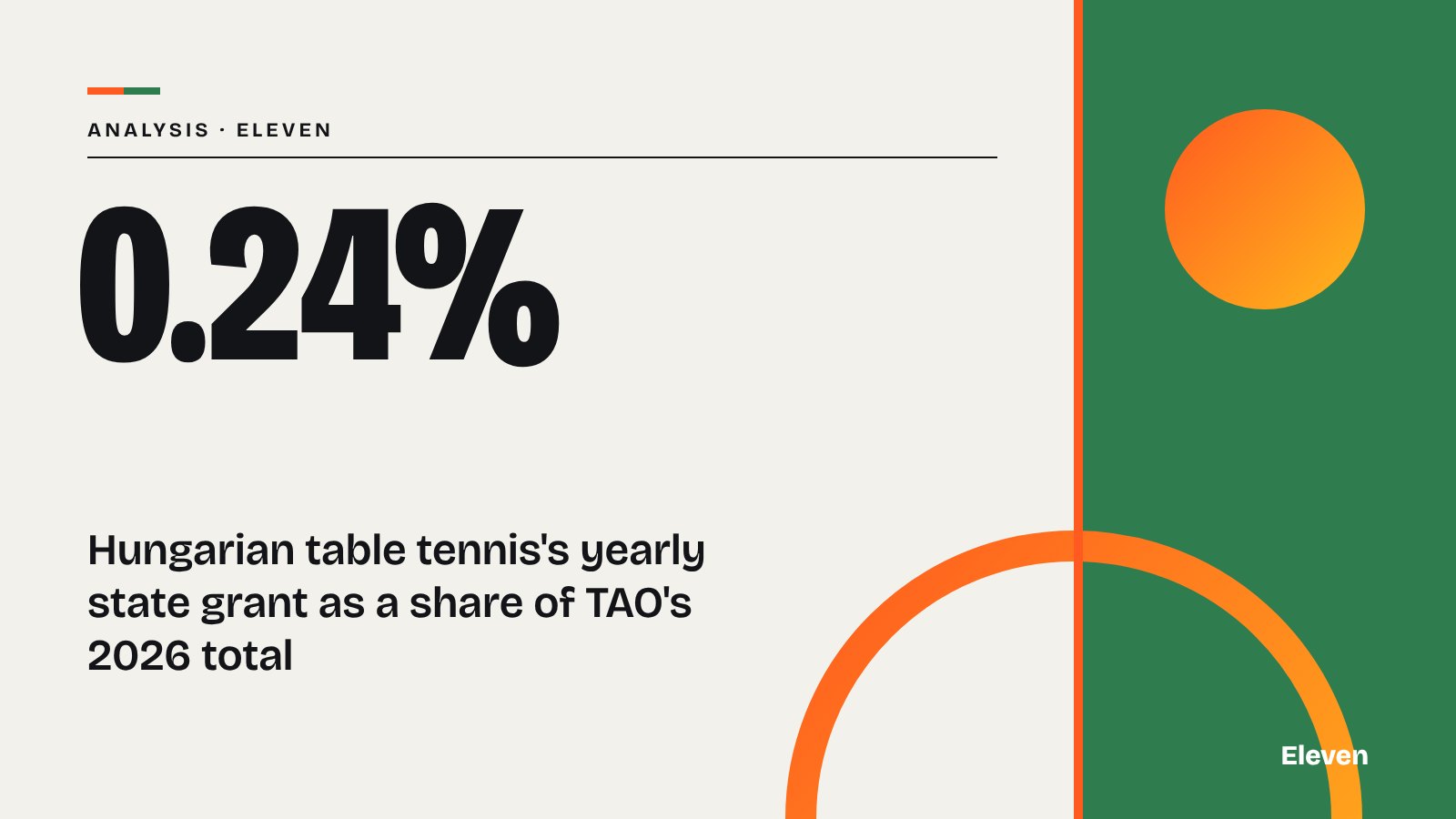
In August 2024 Kovacsics put the federation's state support at about 300 million forints a year and announced a restructuring funded by roughly 100 million a year from new sponsors. In an interview with utanpotlassport.hu published in February 2025 he described the problem underneath: "Coaches simply could not live on the pay they could earn in table tennis" (translated from Hungarian). By last July's licence notice the state grant had been flat for four years. Eleven's comparison is stark: a 300 million forint grant is about 0.24% of TAO's 125.2 billion this year, less than a single day's share of the scheme's annual flow.
The state has not ignored the sport entirely. The Active Hungary secretariat's national table tennis hall development programme for 2026 offers grants of up to 30 million forints for a four-table hall and 50 million for an eight-table one, with projects running until March 2027. The money builds places to play; it does not pay the coaches Kovacsics says the sport cannot keep, which is the gap the English club game also knows well.
What replaces TAO
The new government's plan, set out by Kálnoki-Kiss in November, is a single channel. "Instead of the two, we have worked out a more transparent, single-channel support system," he said on 5 November (translated from Hungarian). At a conference on 12 November he summed up what that means for the sports that lose TAO: "It is not lost, it just transforms." The government has said it will keep total state support for sport at 453 billion forints and will make no change affecting competitive sport in the middle of the Olympic cycle.
Kálnoki-Kiss has also said the change will come slowly, because so much of Hungarian sport now depends on the state. "We cannot make hasty decisions or simply turn off the taps overnight," he told Balkan Insight. "We are taking a gradual approach, reviewing our funding schemes and professional programs with the aim of creating a transparent system in which public money is allocated only to organisations that deliver tangible results and whose work, wherever possible, also has a positive impact on society as a whole."
The mechanics matter more to table tennis than the totals. Under the plan reported by MTI, federations sign transitional agreements from 1 January, the new distribution system starts with the 2027-28 season, and support for competitive sport will be awarded against six criteria: membership and geographical reach, results, youth programmes, recreational programmes, integration, and the quality of the federation's administration. Sponsorship is to become a deductible cost for companies, with tax incentives for patronage. A federation with a modest elite but clubs in every county could, on paper, do better under a formula like that than under one that rewards a handful of stadium sports. Whether it does depends on weightings that have not yet been published, and on how the money that used to flow through TAO is shared out.
His own priorities point the same way. "I do not believe the state should be paying for elite athletes' transfers or salaries, for example," he told Balkan Insight, and he put participation first: "[Interior] Minister Gabor Posfai and I always emphasise that our most important objective is to get as many people as possible to take up regular physical activity."
- Romania18
- Poland15
- Croatia11
- Czech Republic10
- Slovakia10
- Austria9
- Hungary8
- Slovenia6
Eleven counted the nationality of every player in the top 400 of the ITTF men's and women's world rankings for week 46, published on 9 November 2026. Hungary has five men and three women in the top 400.
Source: ITTF world ranking
The ranking is the other half of the case the federation has to make. In the ITTF world ranking for week 46, published on 9 November, five Hungarian men and three women were in the top 400. Csaba András, who plays in the Bundesliga for Bad Homburg, is the best of them at No 57; the highest-ranked woman, Nora Dohoczki, is No 301. Eleven counted every player in the top 400 of both lists by nationality, and Hungary's eight is fewer than Slovakia's or the Czech Republic's ten, and less than half Romania's 18. At Paris 2024 no Hungarian got beyond the second round. The full world ranking shows how far the country of Barna and Mednyánszky now sits from the top of a sport it once owned, in an era when the prize money and the best club contracts sit far from Budapest.
Kálnoki-Kiss's line about TAO was meant to reassure football and handball. For table tennis it reads differently. Hungary's state money for sport is being reshaped, and the six-point formula at least counts the things a club sport has: members, counties, juniors and veterans playing on weekday evenings. The players who beat China in Pyongyang were, in Gergely's words, a team in which all five could play any match. The federation's task now is to persuade a new formula that a sport whose adult players have just been asked for 15,000 forints a year deserves a line in a budget that, for 15 years of TAO, never had one for it.


