On 7 October 1927, representatives of eight teams met at the YMCA in York and agreed to form a league. The YMCA entered two sides; the rest came from the Centenary and Peckitt Street chapels, Holy Trinity, the Deaf Institute and a club called Melrose. The first individual champion, at the end of that season, was Eric Bell, a 17-year-old. A quarter of a century later, writing for the league's silver jubilee handbook, Bell remembered how improvised it had all been. "Half of the bats in use in 1927 were plain wooden ones," he wrote, in a line preserved in the York and District association's own history.
That meeting at the Young Men's Christian Association, with chapel teams and a deaf club around the table, is a fair portrait of how English table tennis was built: by volunteers, in borrowed rooms, one weeknight at a time. It is also, nearly a century on, a fair portrait of how much of it still works. The English club and league game has kept its 1920s skeleton remarkably intact, and the question of whether that skeleton can carry it through the next few decades is the most important one the sport in England faces.
This year it had a stage on which to ask it. The ITTF World Team Championships came to London from 28 April to 10 May, beginning at the Copper Box Arena and finishing at the OVO Arena Wembley, a centenary edition in the city that hosted the first World Championships in 1926. China won both team titles, beating Japan in each final. Sally Lockyer, chief executive of Table Tennis England, the governing body, promised that the event would leave "a meaningful and lasting legacy". The legacy it will be judged on is played far from Wembley, in the 139 local leagues it counted on its TT Leagues results system in 2024-25, in church halls, school gyms and community centres from Plymouth to Northumbria.
- 1900s2
- 1910s4
- 1920s23
- 1930s110
- 1940s46
- 1950s13
- 1960s12
- 1970s6
- Since 19800
- Date unknown10
Eleven counted the foundation year of each of the 226 leagues on Table Tennis England's list of the foundation dates of all English leagues, published in January 2023. Two leagues dated only to "the 1960s" are counted in that decade. The latest dated foundation is Sevenoaks, in October 1978.
Source: Table Tennis England: foundation dates of all English table tennis leagues
A league boom in the 1930s
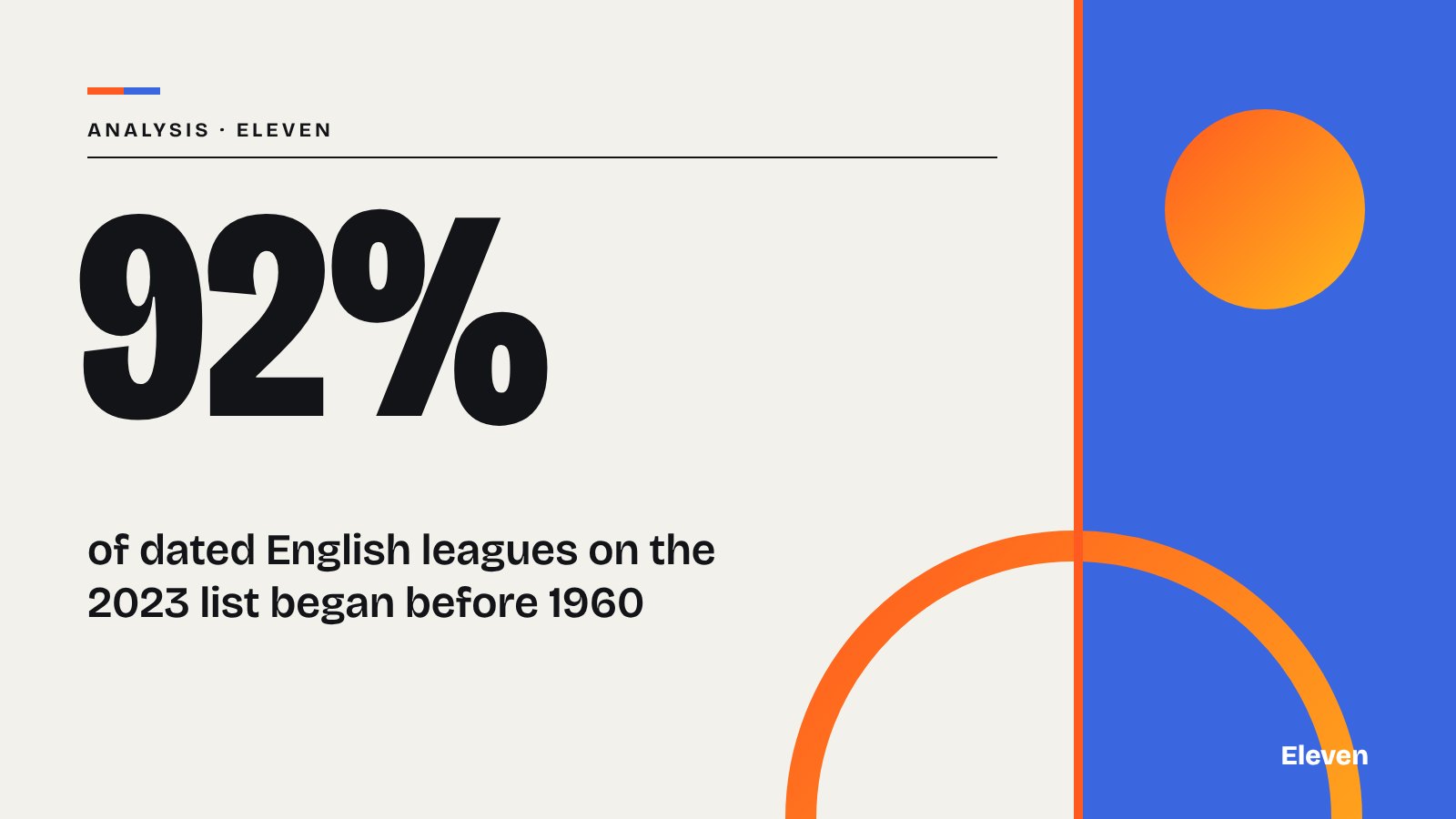
Eleven went through the list Table Tennis England published in 2023 of the foundation dates of every English league, 226 of them, and counted when each began. The result is a striking piece of social history. Exactly 110 of the leagues on the list, almost half, were founded in the 1930s. Another 46 began in the 1940s, most of them in the burst of activity after the second world war. Of the 216 leagues with a known foundation date, 198, or 92%, were founded before 1960. Only six were founded in the 1970s, and none at all after Sevenoaks in October 1978.
The 1930s boom has an explanation. The governing body itself had only just taken shape. Table Tennis England dates its founding to 7 November 1921, when a group of enthusiasts revived the defunct Ping Pong Association; because "Ping Pong" was a registered trade name, the body became the Table Tennis Association in 1922, and in 1927 it was renamed the English Table Tennis Association. Ivor Montagu, the aristocratic film-maker who became the ITTF's first president, was made its president in 1925. Fred Perry won the world singles title in Budapest in 1929, before he turned to lawn tennis. The game was cheap, it fitted in a hall, and it suited a country of chapels, works teams and working men's institutes. By the 1948-49 season, according to the association's handbook of that year, there were 5,000 clubs in 236 local leagues with 75,000 players.
Today's numbers are smaller, though the comparison needs care, because a 1940s "player" and a modern member are not counted in the same way. Table Tennis England had 29,307 members on 31 March 2025, the highest total since the pandemic, and up 6% on the year before. Sport England's Active Lives survey, which asks a large sample of adults what sport they do, estimated that nearly 400,000 adults play the game regularly. Put the two together and roughly 7% of the people who play table tennis in England belong to its governing body. Estyn Williams, then chair of the association's National Council, made the same point in its 2022-23 annual review. "The recent Sport England survey found that 370,000 adults play table tennis regularly. Yet our membership is only about 25,000," he wrote.
- Cadet, 2020-211428
- Cadet, 2024-253565
- Junior, 2020-211134
- Junior, 2024-252023
- Senior, 2020-212174
- Senior, 2024-254614
- Veteran, 2020-2112962
- Veteran, 2024-2518988
Eleven took the membership-by-age table in Table Tennis England's 2024-25 annual review, which counts members at 31 March 2025, and worked out each band's share: veterans were 18,988 of the 29,190 members counted by age, or 65%. The age table totals slightly fewer members than the 29,307 headline figure; the review does not explain the difference.
The gap between the two numbers is the story of English table tennis in miniature. Most people who play do so in a garage, a pub, an office, a park or one of the free outdoor tables that charities and councils have installed in city squares since the early 2010s. Few of them ever find their way to the evening league, which is still the core of what the governing body organises and what most of its members join to play in.
Who those members are is the other half of the picture. Table Tennis England sorts them into four age bands, and in its 2024-25 annual review 18,988 of the 29,190 members it counted by age were in the oldest, the veterans. That is 65%, almost two in three. Women and girls made up 3,980 of the members counted by sex at the end of May 2025, about 13%. Neil Hurford, the chair of the National Council, put it bluntly in both of the last two annual reviews, in identical words. "Many counties are facing the challenges of declining membership and in some cases leagues closing," he wrote.
Why leagues are shrinking
The decline is older than any one crisis. Answering members' questions in 2023, Table Tennis England said that about a third of local leagues had stopped playing since the London Olympics in 2012, and that the number of clubs and players in leagues had fallen by a similar amount; it added that it did not hold comparable figures going back to the 1960s. Local histories fill some of the gap. In Hastings, where the league was founded in 1927 and where the national association kept its head office until it moved to Milton Keynes in 2014, more than 100 three-a-side teams played each week in the mid-1980s, the Hastings Independent Press reported in 2016. By 2015-16 there were 35 teams from ten clubs. The youngest player in the champion club was 29. In Maidstone, whose league dates from 1919, there were once eight divisions and 100 teams.
Part of the reason is the format, which has barely changed since the clubs of the 1930s settled it. The standard English league match is three players against three, each playing all three opponents, plus a doubles: nine singles and one doubles, often on a single table. In Hastings, match nights start at 7.30pm. York, which played with teams of four after the war, cut them to three in 1951-52, with nine singles at the heart of each match. It is a rhythm that suited an era of fixed working hours and few rival attractions. A match in the lower divisions in Hastings, the 2016 report noted, could still take three hours or more. A blog on Table Tennis England's website in September 2025 argued that matches running past 10.30 or even 11pm were driving out working-age players and parents first, and pointed to Leamington, which now offers a quicker two-a-side format alongside the traditional one. In 2021, 16% of leagues told the governing body they had adopted a shorter format.
The other reason is the rooms. English table tennis never built its own buildings on any scale; it rented other people's. That dependence was laid bare in August 2020, when Table Tennis England surveyed 337 clubs about returning after the first lockdown. Clubs in dedicated table tennis venues had largely come back: 72% were already playing. Among clubs based in church halls and other religious buildings, 94% could not return, and only one of 18 had resumed. Of the clubs still shut, 65% blamed a closed venue or one that would not take outside hirers. "Only around 45% of our clubs have been able to return to play or have a confirmed date for doing so," Sara Sutcliffe, then the governing body's chief executive, said at the time.
Most of those clubs did come back, but not all of them. When Table Tennis England audited 77 league organisers in late 2021, 3% had no plans to restart, usually because they had lost suitable venues, and most of the rest had fewer teams and players than before the pandemic. Membership stood at 81.5% of its pre-pandemic level. "We recognise the challenges that leagues are under to engage young players and volunteers," said Greg Yarnall, its head of development and volunteering. The economics of replacing a lost hall are severe. When the Maidstone league set about opening a dedicated centre, the club behind it needed room for at least 12 tables and at least £20,000, according to Table Tennis England's account of the project in January 2025.
Volunteers are the third pressure, and the least visible. Every English league is run by unpaid secretaries who chase scorecards, book halls and arbitrate disputes about lets and service faults. Bob Coull, writing on the website of the Central London league, founded in 1943, as it expanded to seven divisions in 2024, made a plea that will be familiar to anyone who has sat on a league committee. "The League functions based on the help of volunteers. We are currently short of Divisional Secretary volunteers," he wrote.
The cost shows up at the bottom of the age range. Brian Vibery, chairman of the New Milton club in Hampshire, told the Bournemouth University news site Buzz in November 2025 that his club's juniors had disappeared from league play. "15 years ago we had 20 juniors representing the club, now we haven't got any representing our teams in the league," he said. Matthew Daish, a player who represented England at youth level and now runs the club's coaching sessions, identified a problem that starts long before a child reaches a club. "A lot of schools I have been contacting do not even have a table for people to play on," he said.
- Germany (DTTB), 1 January 2025542063
- France (FFTT), 2024-25222933
- England (Table Tennis England), 31 March 202529307
Eleven compared the most recent published totals: the German federation's memberships in the DOSB's 2025 count, the French federation's competition and leisure licences for 2024-25 (leaving out short-term event and discovery passes) and Table Tennis England's total membership. Each body counts members in its own way, so the comparison shows scale rather than exact equivalence.
Source: DOSB Bestandserhebung 2025; FFTT activity report 2025; Table Tennis England annual review 2024-25
Signs of recovery
The figures are not all one way, and to read them as a simple story of decline would be wrong. Membership has risen every year since it fell to 17,698 in 2020-21, the first pandemic season. The number of cadets, the youngest band, has more than doubled in that time, from 1,428 to 3,565, and membership is now free for children under 11. The Club Play category, for members who play at a club without competing, grew 16% in 2024-25 to 5,134. The national British Clubs Leagues had 846 teams and 4,397 players in 2025-26. Active Lives recorded an 11% rise in adult players, and a 22% rise among women. Lockyer made the most of it in her report for 2024-25. "The growth in our sport is evident, and the potential for so much more is clear," she wrote.
Even so, the trend line has only just got back to where it was. A membership plan written for the governing body in 2022 recorded that when Covid struck, membership was 29,072. Five years later, the total is a few hundred higher, while the number of adults playing has grown. The sport is gaining players faster than the structure built to hold them.
The comparison with England's neighbours makes the scale plain. The German Table Tennis Federation had 542,063 memberships at the start of 2025, according to the German Olympic Sports Confederation's annual count, spread across 9,138 clubs and club sections; Germany has less than one and a half times England's population and 18 times as many members. France, with a slightly larger population than England, had 222,933 competition and leisure licences in 2024-25, a total that, as an earlier Eleven feature on the Lebrun effect showed, has grown sharply since Félix and Alexis Lebrun emerged. Both countries organise the game around clubs that field teams at every level, from village divisions to professional leagues, so that the local player has a ladder to look up. England's model, a federation of evening leagues renting rooms by the night, has never generated that density.
None of this is new to the people inside the sport, who have argued about formats, venues and juniors for as long as most of them have played. What has changed is how hard it is to start again. A league that loses its hall, its secretary and its last few teams tends to stay lost: of the leagues still on the foundation list in 2023, not one was founded after 1978. The players who filled the arenas in London this spring went home to club systems in Germany, Japan and China that are built to keep producing players. The test of the centenary is whether England's clubs can do the same before the next one.
Eric Bell did not live to see what became of his league. He died in December 1952, aged 42, in the season of its silver jubilee. The league he helped found is still playing. So are 22 others on the list that began in the 1920s and 110 from the decade that followed, most of them run in the same way, in the same kind of rooms and to the same timetable. That endurance is the English game's great achievement. Whether it lasts another century depends on how many new players those leagues can find room for, and how many of them stay to run things.
Want to play? Eleven's guide to finding a club in England explains how to find a league and a club near you.


