On Sunday 4 August 2024, in an exhibition hall at the Porte de Versailles that the Olympic organisers had renamed South Paris Arena 4, Félix Lebrun needed 31 minutes to beat Hugo Calderano of Brazil 11-6, 12-10, 11-7, 11-6 for the bronze medal in the men's singles. He was 17, and he holds his bat in the penhold grip, pinched between thumb and forefinger like a pen, a style rare among European players. The hall held 6,500, and France 2 put the match in front of 5.8 million viewers, a 43.1% share of everyone watching television at the time. "It's incredible, I have no words," he said afterwards, as reported by Media365 (translated from French).
Five days later he won the deciding match against Japan's Hiroto Shinozuka to give France the bronze in the men's team event, a 3-2 win in which he had already beaten Tomokazu Harimoto. His brother Alexis, three years older, had partnered Simon Gauzy to win the doubles that opened the tie. They were France's first Olympic medals in table tennis since Sydney 2000, and the first ever in the sport's team event.
French sport has a phrase for what followed: l'effet Lebrun, the Lebrun effect. The term was already in print by February 2024, before the Games, but the medals turned it into a figure that the French Table Tennis Federation (FFTT) could put on a press release. In the 2024-25 season the federation issued 254,110 licences, the membership cards that every player in a French club needs, and the most in its 98-year history. A season on, the total has dipped for the first time since the Games. So has one family changed French table tennis, or did it lend the sport a summer? Eleven went through the federation's own statistics, season by season, to find out which part of the boom has stayed.
The brothers were close to the game from birth. Alexis was born in Montpellier on 27 August 2003 and Félix in the same city on 12 September 2006. Their father, Stéphane Lebrun, was once ranked seventh in France and won a national doubles title; their uncle, Christophe Legoût, played at three Olympic Games and has since worked as the federation's sporting director. Félix took up the penhold grip at about the age of four, copying the Chinese player Chen Jian. He won his first title on the World Table Tennis (WTT) circuit, the professional tour that runs the sport's biggest tournaments, at WTT Contender Antalya in October 2023, beating Germany's Dimitrij Ovtcharov 4-3. He is now the world No 2 on the ITTF world ranking, with Alexis ninth, and last month he became European champion in Ljubljana, beating Sweden's Anton Källberg 4-3 with an 11-1 final game.
A century of French table tennis
The effect they are credited with lands in a country that took to the game early and then spent most of a century keeping it in the hall. Table tennis began as a parlour game in Victorian England; in 1901 the London firm Jaques registered "Ping-Pong" as a trademark. Within a year it was a craze in Paris. The historian Kilian Mousset and his co-authors have shown that in 1902 ping-pong was a fashion of French high society, carried along by anglomania and by the novelty of a game that men and women could play together. Like most fashions it passed. The competitive sport arrived later: the International Table Tennis Federation (ITTF) was formally constituted in London in December 1926, and the FFTT was founded in Paris on 30 March 1927, three months after it. France was not among the ITTF's founder members and joined in January 1929.
The federation's own history counts the growth that came next. When it made the licence compulsory in the 1933-34 season, 5,128 players took one. That winter Paris staged the World Championships for the first time, in December 1933, the edition the ITTF records as 1934. In March 1944, with the country under occupation, there were 10,001 licensed players in 605 clubs. The total passed 20,000 in 1952 and was approaching 35,000 by 1967. Paris held the World Championships again in 1947, and would do so twice more, at Bercy in 2003 and 2013.
French table tennis has had heroes before, and the numbers have moved with them, if not always in step. Jacques Secrétin, born in the mining town of Carvin in 1949 and the most flamboyant entertainer the French game has produced, won the European singles title in Prague in 1976 and the world mixed doubles with Claude Bergeret in Birmingham in 1977, France's first world title of any kind. That June the federation counted 65,319 licences in 3,220 clubs. Jean-Philippe Gatien went further: Olympic silver in Barcelona in 1992, where Sweden's Jan-Ove Waldner beat him in the final, and then, on 23 May 1993 in Gothenburg, victory over Belgium's Jean-Michel Saive to become France's first world singles champion. "That victory changed everything, it took me into another dimension," Gatien told L'Humanité on the 20th anniversary of the title, as quoted by the FFTT (translated from French). In Sydney in 2000 he and Patrick Chila won bronze in the men's doubles.
Whether Gatien's title filled the clubs is harder to say than it ought to be. The federation has not published a season-by-season series for the 1990s, and Eleven found no reliable count of a "Gatien effect". What the published figures do show is that by the middle of the last decade the French game had reached a plateau. The FFTT issued 207,213 licences in 2015-16 and 211,462 in 2018-19. Then came the pandemic, which closed sports halls across the country: in 2020-21 the total fell to 133,754.
- 2015-16207213
- 2018-19211462
- 2019-20201548
- 2020-21133754
- 2022-23211042
- 2023-24228014
- 2024-25254110
- 2025-26246501
Eleven took every season for which the FFTT has published a total including event and discovery licences: 2015-16, 2018-19 and 2022-23 to 2024-25 from its 2025 activity report, 2019-20 as reported by tennis2table, 2020-21 from its season statistics and 2025-26 from its key figures page. Seasons without a comparable published total are left out.
Source: FFTT activity report 2025; FFTT statistics; tennis2table
Counting the effect
The recovery was under way before the brothers became famous, which matters for any honest account of what they did. By 2022-23 the total was back to 211,042, a little below where it had been before Covid. It was the next two seasons that broke the ceiling. In 2023-24, the season in which Félix won in Antalya and the phrase effet Lebrun first appeared, the federation issued 228,014 licences, then its record. In 2024-25, the Olympic season, it issued 254,110.
Gilles Erb, the federation's president, has given a bigger number. "Since the Games, we have seen a 23% increase in the number of licence holders," he told Europe 1 at the French championships in Levallois in 2025 (translated from French). In an interview with Sport Stratégies, reprinted by the FFTT, he called it the strongest growth of any federation "in the whole French sports movement in 2024". The two figures are both right, and the difference between them explains most of what follows. A French licence comes in several kinds. A competition licence lets you play in leagues and tournaments; a leisure licence lets you train at a club without competing; event and discovery licences are short-term passes handed out at open days and one-off events. The federation's year-end figures show how the numbers fit together. Annual licences, competition and leisure combined, rose by 21.7% in 2024-25, to 222,933, close to Erb's figure. The headline total rose by only 11% because event passes fell by a third.
On the ground, the rise looked less like a statistic than a queue. "We had anticipated it at club level. We are not surprised by the influx of new members, but by the enthusiasm," Stéphane Lebrun, who manages his sons' club, Alliance Nîmes-Montpellier, told Brut in the autumn of 2024 (translated from French). The club's first league match after the Games drew more than 2,500 spectators to a hall in Castelnau-le-Lez, because its own could not hold them. "Our hall, which holds 200 spectators, will be renovated, but it cannot be made bigger," he said.
The pattern repeated across the country. In Île-de-France, the region around Paris, the regional league counted 26,000 licence holders at the end of October 2023 and 34,000 by November 2024. "Our training courses are exploding," Patrick Beaussart, its president, told SportMag in November 2024 (translated from French). The national championships changed too. At Levallois in 2025, where 2,850 seats were sold out on the Saturday and the Sunday, Legoût told Europe 1: "It's night and day. Everything is multiplied by 50 or 100 compared with what we lived through" (translated from French). In the morning, before the doors had even opened, he said, "there were people with signs trying to buy tickets, like at Roland-Garros". In October 2024 he had reached for a comparison from another sport: "they have gone beyond the bounds of their sport, it reminds me a bit of Laure Manaudou in 2004", the swimmer who won Olympic gold in Athens at 17.
- 2020-2183938
- 2021-2293413
- 2022-23102178
- 2023-24106716
- 2024-25120698
- 2025-26124188
Eleven took the competition licence count from each of the FFTT's published season statistics, 2020-21 to 2024-25, and from its key figures page for 2025-26. The federation's 2024-25 figure is published as competition and officials' licences together.
Source: FFTT season statistics
The professional game followed the crowds south. In October 2024 Montpellier staged the first WTT Champions Montpellier, one of the tour's elite 32-player events, and Félix won it, beating Harimoto 4-1 in the final to become the first Frenchman to win a WTT Champions title. "Having a WTT tournament at home, we had dreamed of it," he had said before it began (translated from French). The 2025 edition sold 43,265 tickets, which the federation describes as the biggest attendance at any WTT event outside China.
Will it last?
- March 194416.5
- June 197720.3
- 2023-2459.0
- 2024-2571.6
- 2025-2670.0
Eleven divided licences by affiliated clubs: 10,001 by 605 in 1944 and 65,319 by 3,220 in 1977, from the FFTT's history; for the recent seasons, competition plus leisure licences (183,143, 222,933 and 220,945) by 3,102, 3,114 and 3,155 clubs, leaving out short-term event and discovery passes that did not exist in the earlier years.
Source: FFTT: role and history; FFTT activity report 2025; FFTT statistics
Booms are easy to start. Erb knew where the risk lay: in the same Sport Stratégies interview, looking ahead to the return of clubs in September 2025, he said: "We know it: if half of them don't come back, we lose all the momentum" (translated from French). Beaussart had already named the task in Paris: "The priority this year is to keep all the new members who signed up at our clubs in the Paris region."
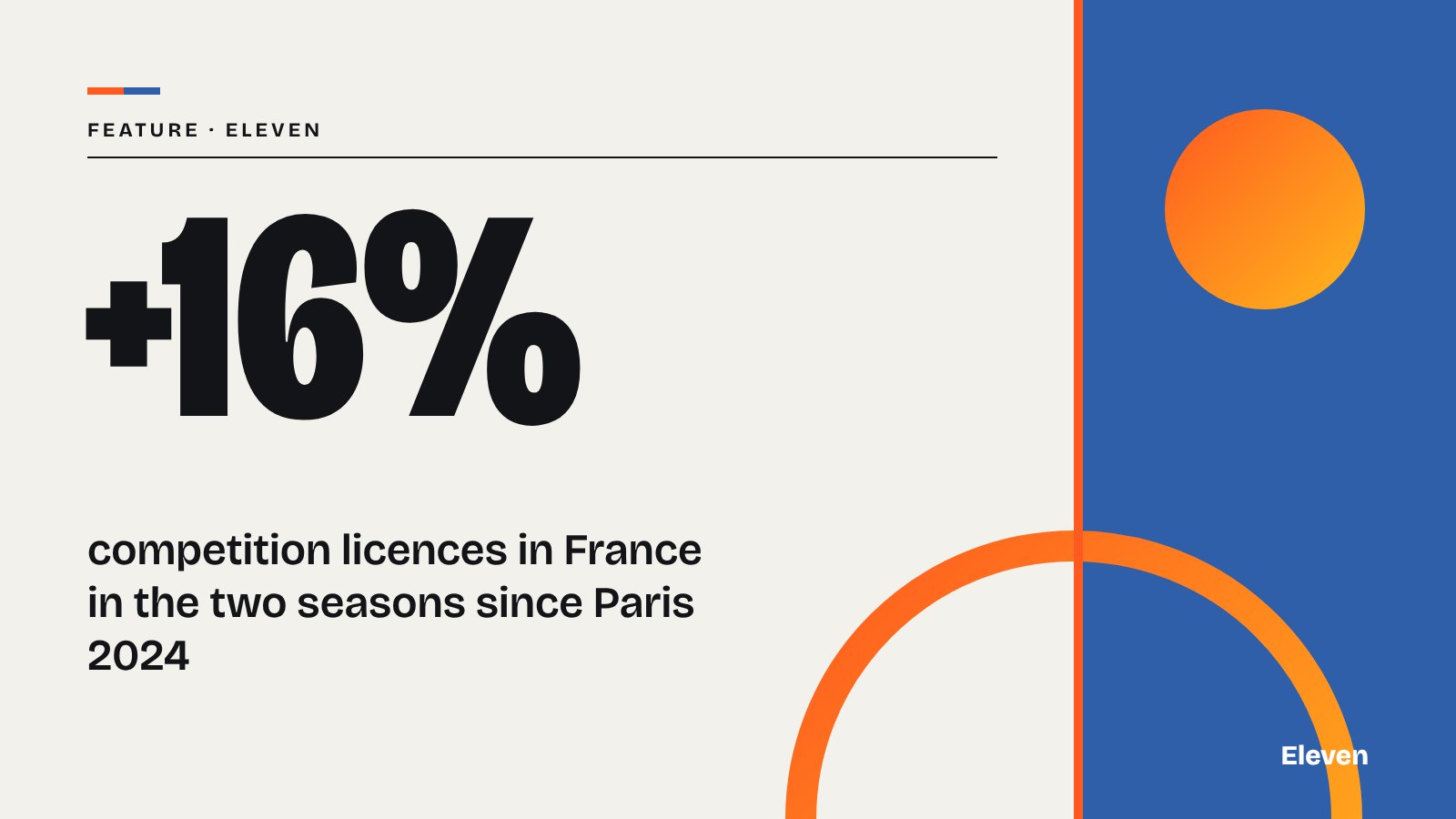
The 2025-26 figures, now published on the federation's statistics page, give the answer, and it is better than a sceptic would have guessed. The total fell by 3%, to 246,501. But at its general assembly in December 2025 the federation had planned for 229,000, so it finished well above its own forecast. The fall came where a fading fashion would show itself: leisure licences dropped by 5%, to 96,757, and event passes fell again. Competition licences, the ones held by people who want to play matches for a team, did the opposite. They rose to 124,188, up 16% on the last season before the Games and 48% on the Covid low of 2020-21. Eleven compared the six seasons the federation has published by licence type, and each has more competitors than the one before.
That is the part of the effect that looks permanent, and it is the part that will shape the French game, because competitors are the players who fill a league's divisions and, in time, its coaching courses. It is also lopsided. Women held 17% of licences in 2025-26, up from 13% of club licences in 2020-21, and they are about one competitor in 10. Jean-René Mounié, the federation's high-performance director, was candid about the elite end of that gap when France named its squad for this month's Mixed Team World Cup: the men dominate Europe, he said, while for the women "the gap with the best in the world remains significant", as Eleven reported. Claude Bergeret won a world title for France in 1977; nearly half a century later, French women's table tennis is still waiting for its own Lebrun.
The other limit is the one Stéphane Lebrun described: rooms. France has fewer table tennis clubs than it did a generation ago. In 2012 the federation had 3,600 affiliated clubs; today it has 3,155, fewer than the 3,220 of June 1977. Eleven divided each season's annual licences by the number of clubs. In 1944 there were about 17 licensed players for every club, and in 1977 about 20. In 2023-24 there were 59, and since the Olympics there have been about 70, which means the new players have been absorbed by existing clubs adding sessions in the same halls rather than by new clubs opening.
Gatien, who knows what a single champion can and cannot do for a sport, told Europe 1 that "they are exceptional competitors, with enormous talent and above all still enormous room for improvement" (translated from French). It is the most useful thing a former world champion can say about the Lebrun effect, because it describes something that has not yet finished. Félix is 20 and Alexis 23. The Olympic medals filled the halls in a single summer; the competition licences, still climbing two seasons later, show that a good share of those who came have stayed to play. The constraint now is concrete: a club in Montpellier with the most famous players in French sport, and a hall of 200 seats that cannot be made any bigger.


