This is part two of two. Part one, WTT's money, part one: China's money, and where it actually goes, looks at what China contributes to WTT and how tournament money there is shared between hosts and WTT.
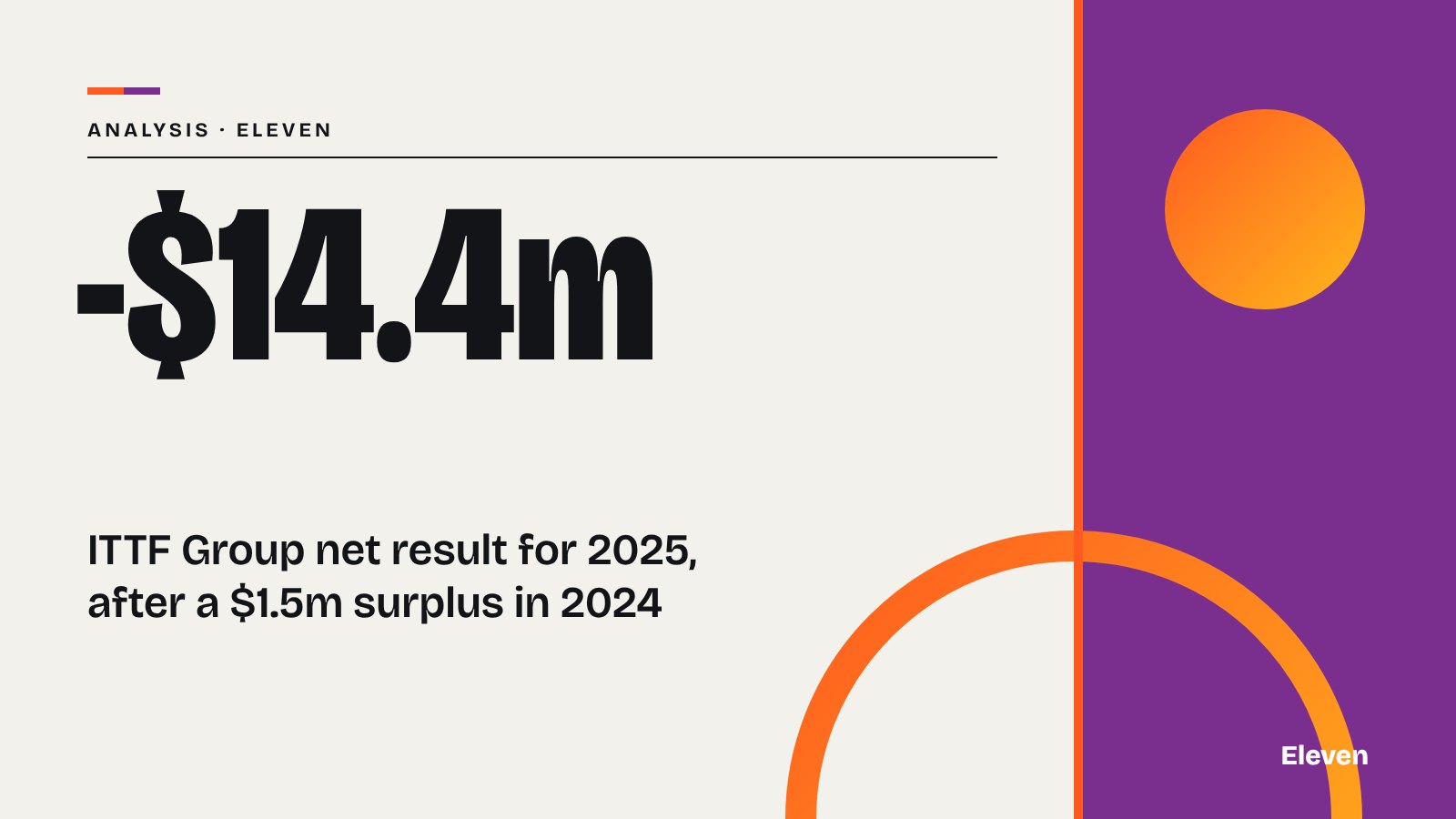
In 2024 the ITTF made money. In 2025 it lost $14.4m. Those two figures, from the group's consolidated accounts, frame the question of how professional table tennis pays for itself, and they are the most detailed figures the sport has published about its own business.
WTT is part of that group. The ITTF's statement on its 2023 and 2024 accounts says WTT recorded its first profit in 2024, contributing to a group surplus of US$1.5m. The 2025 accounts show a group net deficit of US$14.4m. Those accounts cover the whole group, not WTT alone, and WTT does not publish standalone figures, so the business that runs the events cannot be separated from the federation that owns it.
Where the money comes from
The published record and press reports point to four main sources of income for WTT and its group.
- Commercial rights. Sponsorship, media and streaming rights, hosting rights, and betting and data rights. Since 2020 IMG has handled WTT's media rights, production, sponsorship sales and betting data.
- Event income. Ticket sales, hospitality, merchandise and local sponsorship, which are kept or shared depending on each host's agreement.
- Hosting fees. Cities and organisers pay to stage events, often with public funding.
- Investment. An outside investor holds a 15% stake in WTT, and the ITTF sold a further 10% for US$12.1m, according to the 2025 accounts.
The accounts do not give a standalone figure for each stream. They report revenue in a small number of lines, and the most important of those is commercial rights. Sponsorship, media and hosting rights are grouped together, so it is not possible to see how much of the largest line comes from any single source.
What the 2025 accounts show
- Total income, 202461.2US$m
- Total income, 202571.1US$m
- Total expenses, 202459.6US$m
- Total expenses, 202585.5US$m
Eleven took the totals from the ITTF's 2025 consolidated statements. Expenses rose 43% and income 16%. The net result swung from a US$1.5m surplus to a US$14.4m deficit.
Total income for the group rose from US$61.2m in 2024 to US$71.1m in 2025, an increase of 16%. Total expenses rose from US$59.6m to US$85.5m, an increase of 43%. The result swung from a surplus of US$1.5m to a deficit of US$14.4m. Costs grew nearly three times as fast as income.
- Commercial rights, 202441.0US$m
- Commercial rights, 202539.7US$m
- Event income, 202411.3US$m
- Event income, 202522.8US$m
Eleven took these lines from Note 15 of the statements. As shares of total revenue (US$52.8m in 2024, US$62.9m in 2025), commercial rights fell from 78% to 63% and event income rose from 21% to 36%.
Source: ITTF consolidated financial statements 2025, Note 15
The mix changed more than the total. Commercial rights income, the largest line in 2024, fell slightly, from US$41.0m to US$39.7m. Event income, which covers what the group earns from running events, roughly doubled, from US$11.3m to US$22.8m. Eleven worked out the shares of total revenue: in 2024 commercial rights made up 78% and event income 21%. In 2025 the shares were 63% and 36%.
That shift matters. Event income carries the costs of running tournaments, from venues and broadcast production to staff and player logistics, so the more the group earns from events, the more of their risk it carries. The 2025 accounts show that cost growth outpaced income growth, and that the new event revenue did not cover it.
The balance sheet shows the effect. Current liabilities exceeded current assets by US$20.2m at the end of 2025, up from US$7.3m a year earlier. The auditor draws attention to a "material uncertainty related to going concern" and says its opinion is not modified in respect of that matter. The sale of a further 10% of WTT in 2025 brought in US$12.1m.
Ownership
WTT is majority owned by the ITTF. The 2025 accounts say World Table Tennis Pte Ltd was 85% owned by the group in 2024 and 2025, with 15% held by an outside investor, and record the sale of a further 10% for US$12.1m. The ITTF's 2025 statement says the release of its 2023 accounts "took longer than anticipated" because of the restructuring of "value-in-kind agreements with WTT investors", the reclassification of some assets and a change of auditors.
What single events show
Tournament-level figures are scarce, and the accounts do not provide them. Eleven found two reference points. The first is the China Smash, where the organisers announced close to RMB60m of box office in 2024. The second is the US Smash. The South China Morning Post reported in June 2026 that many opening-day tickets were unsold, and attributed an eight-figure deficit in the 2025 accounts to WTT. The statements read for this piece record the result for the group as a whole and do not name the US Smash or WTT, so that attribution is the newspaper's.
- ITTF Group85%
- Outside shareholder(s)15%
The 85% and 15% split is from the ITTF's 2025 accounts.
Source: ITTF consolidated financial statements 2025, Note 2.3; Mail & Guardian
This pattern is common in sport. A host can accept a loss for publicity, tourism and prestige, and the event owner can still earn fees. Whether the arrangement works for WTT depends on how much of each event's income it keeps, and on the cost of the venue, production and travel that it takes on. The published accounts do not give figures for individual events.
Where the next money might come from
WTT is looking at India. Ultimate Table Tennis (UTT) has a three-year domestic broadcast deal with JioStar running to 2027, and UTT reported 20 million viewers across TV and streaming in 2024, a 1.3-times increase on the year before. A SportBusiness report describes WTT setting up a majority-owned Indian company, WTT Event Management India, at a cost of between US$3m and US$5m, with talks with UTT's chair, Vita Dani, about outside investment. Dainton said: "We have a big job to do, not only in broadcast, but in sponsorship, and in general awareness."
That is an investment in a market with a large audience and a short commercial history. If WTT can turn India's domestic audience into sponsorship and media revenue, it would add a second major market in Asia alongside China. As with the US, the first years are likely to cost more than they earn.
Where things stand
The growth is clear. Commercial and events revenue grew from US$16m in 2019 to more than US$52m in 2024. Prize money rose from US$5.3m to more than US$10m over the same period, according to Dainton's presentation to the 2024 AGM. WTT made its first profit in 2024, and the ITTF says its reserve remains stable at US$6.8m.
The 2025 result shows the cost of that growth. Costs rose faster than income as the group took on more of the running of events, and current liabilities exceeded current assets at the end of the year. The accounts do not split revenue by market, so they do not show how much is earned in China.
China Daily reported Dainton's view that newer markets typically need two to three years to mature commercially. The 2025 accounts suggest the group is paying for that maturing period now, and the next set of accounts will show whether the expansion is paying back.
The 2024 profit shows the model can make money in a good year, and the 2025 accounts show what it costs to grow. The 2026 accounts will show whether the investment in new markets is starting to pay back.


