On Monday 28 September, on the last day of the table tennis at the Asian Games in Nagoya, Wang Chuqin lost the men's singles final 4-0 to his teammate Lin Shidong. Two days later WTT announced that both men had withdrawn injured from China Smash in Beijing, a Grand Smash that started the next morning. Wang had been the world No 1 for much of the year. He missed the Asian Championships in Tashkent, pulled out of WTT Champions Montpellier, and did not play another international match until Tuesday, when he beat Denmark's Anders Lind in Frankfurt and told Jimu News he was still feeling his way back. By then he was fourth in the world rankings.
He was the returning exception. Frankfurt had been losing players all week. Wang Manyu, the women's world No 1, Lin Shidong and Alexis Lebrun were withdrawn injured on the eve of the tournament, and Sun Yingsha pulled out a day after winning in Montpellier. Félix Lebrun, the men's world No 2, is not in the draw either. That makes five of the 20 players in the two top 10s absent from WTT Champions Frankfurt, the second Champions event in a week.
So the question being asked across the sport this autumn is how much the season asks of the players. Eleven counted every match the current top 20 men and women have played on the WTT tour since mid-June to see where the load falls. The busiest players on the tour are mostly not the ones who have been injured, and much of the rest of the season happens away from WTT's events.
How the calendar grew
Some history first, because the crowding is new. For most of the sport's life the calendar was one week long. The International Table Tennis Federation was formed in 1926, and the first World Championships were held in London from 6 to 11 December that year, an event first staged as the European Championships and only later designated the first Worlds. For three decades the Worlds were the season's summit, and from 1957 they were held every other year. In between, players had national championships, international opens and long stretches of training.
- ITTF Pro Tour, 199610events
- ITTF Pro Tour, 200514events
- ITTF World Tour, 201912events
- WTT, 202625events
Eleven counted the senior tournaments on each tour, excluding the season-ending Grand Finals or WTT Finals. The 2026 figure is from WTT's published results and calendar: four Grand Smashes, six Champions, six Star Contenders and nine Contenders. World Championships, World Cups, continental events and WTT Feeder events are not included.
The sport added layers slowly and then quickly. The men's World Cup began in 1980; the women's did not follow until 1996, the same year the ITTF launched its Pro Tour with 10 tournaments and a Grand Finals. From 2003 the World Championships split into individual and team editions in alternate years, so there was a Worlds every year. The tour grew to 14 events in 2005 and was still at 12 in 2019, its last full season under the ITTF World Tour name. That was the year the ITTF announced World Table Tennis, on 30 May 2019, as a new commercial vehicle for the sport. Its first event, a 32-player showcase in Macao, was played from 25 to 29 November 2020.
WTT was set up to build bigger events around the leading players, and the calendar has grown with it. Counting the event results WTT publishes, Eleven found 26 senior WTT tournaments on the 2026 calendar: four Grand Smashes, six Champions events, six Star Contenders, nine Contenders and the Finals in Hong Kong in December. Leaving the Finals aside, that is 25 tour events against the Pro Tour's 10 in 1996. On top of that sit the ITTF's own World Cup, World Team Championships and Mixed Team World Cup, continental championships, and in Asia this year a multi-sport Games.
The tiers matter. Nobody expects the world No 3 to play a Contender in Lagos. But the top tier alone, Grand Smashes, Champions and Star Contenders, is 16 events, and Grand Smashes now run for nine to 11 days. The Champions events in Montpellier and Frankfurt this autumn were scheduled back to back, the first ending on Sunday 1 November and the second starting on Tuesday 3 November. For Asian players, both came straight after the Asian Championships, which ended in Tashkent on 25 October.
For a time, the rules also made many of those events compulsory. WTT's 2025 handbook, published in December 2024, introduced stricter penalties for late withdrawals: seeded players who pulled out of a main draw faced double fines and were barred from any other event that week, including club matches. Before the month was out the two Olympic singles champions, Fan Zhendong and Chen Meng, withdrew from the world rankings altogether. "I am sure I was never informed by officials before that I would be fined for withdrawing from the competition," Fan wrote on Weibo (translated from Chinese), as reported by the South China Morning Post. WTT replied that rules on which events players must attend were nothing new.
The Chinese Table Tennis Association also raised the issue. "Players are the most valuable assets in any sport, and should be treated with care," Liu Guoliang, the president of the Chinese Table Tennis Association, said in a statement reported by China Daily, proposing participation exemptions for veteran players. The ITTF set up a task force in January 2025, and in February WTT removed the mandatory participation requirement for the Grand Smashes and allowed two annual exemptions from Champions events. The change made attendance a matter of incentive rather than obligation: ranking points, prize money and Olympic selection still reward turning up.
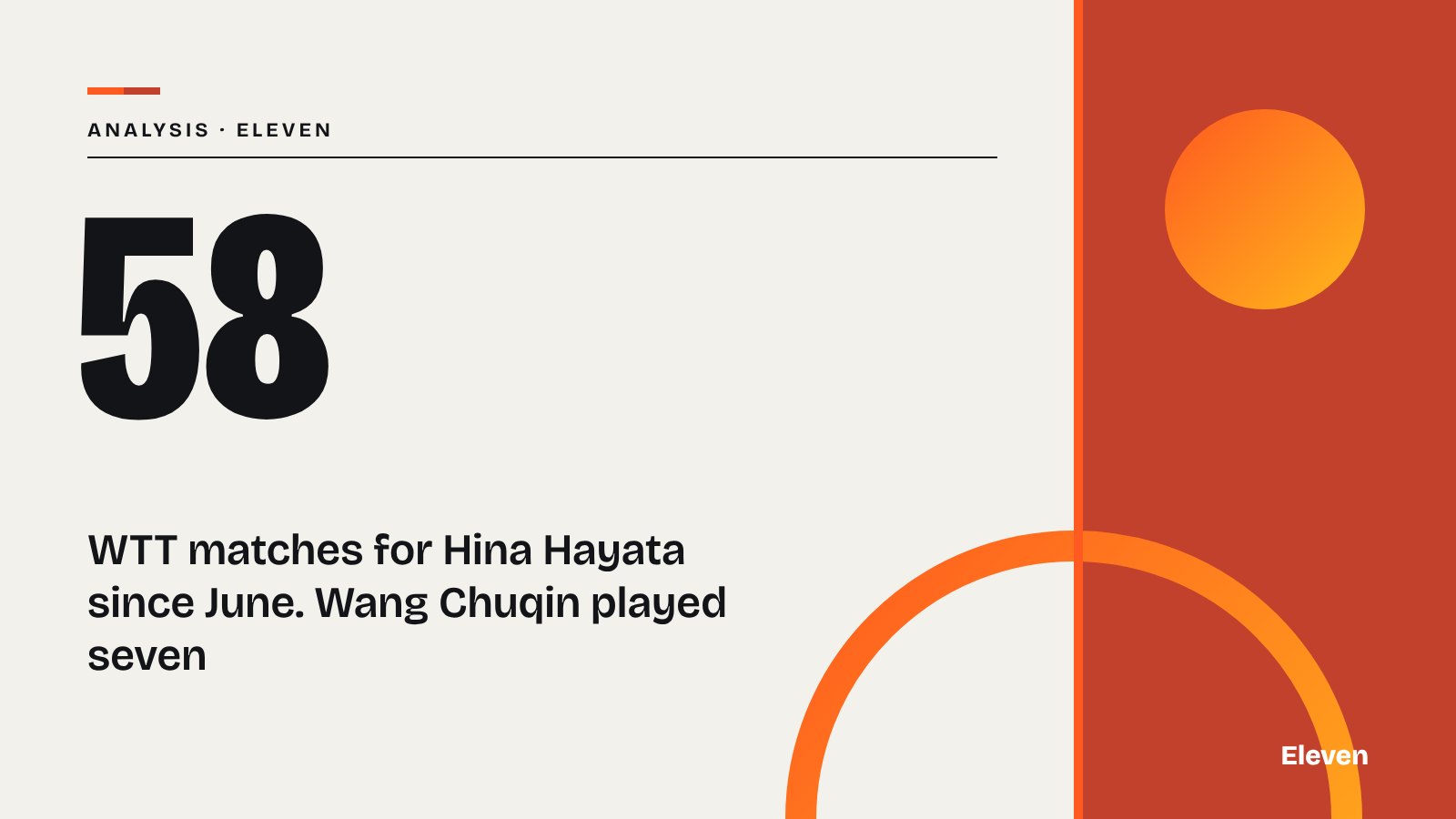
- Hina Hayata (women's No 6)58matches
- Miwa Harimoto (women's No 3)53matches
- Alexis Lebrun (men's No 9)49matches
- Kuai Man (women's No 4)49matches
- Wang Yidi (women's No 5)46matches
- Shunsuke Togami (men's No 16)43matches
- Hugo Calderano (men's No 7)42matches
- Sora Matsushima (men's No 1)35matches
- Wang Manyu (women's No 1)26matches
- Lin Shidong (men's No 10)21matches
- Sun Yingsha (women's No 2)17matches
- Wang Chuqin (men's No 4)7matches
Eleven counted every singles, doubles and mixed doubles match played by each player in the 2 November 2026 top 20 at the 11 senior WTT events from Star Contender Ljubljana to Champions Montpellier, using WTT's official match records and excluding walkovers. The averages were 31 matches for the women's top 20 and 28 for the men's. Asian Games, continental championships and club matches are not included.
Source: World Table Tennis official results; ITTF world ranking, 2 November 2026
Counting the matches
Here is what turning up looks like now. Eleven took WTT's official match records for every senior tour event from WTT Star Contender Ljubljana, which began on 16 June, to the end of WTT Champions Montpellier on 1 November, and counted the matches each player in this week's top 20 actually played, in singles, doubles and mixed doubles. That is 11 events in 139 days. Hina Hayata, the women's world No 6, played 58 matches across nine of them, on 38 different days, and logged about 35 hours of match time. Miwa Harimoto played 53. Among the men, Alexis Lebrun played 49 matches at nine events, more than anyone else in the men's top 20.
At the other end of the chart are the players whose injuries have dominated the autumn. Wang Chuqin played seven WTT matches in the period, all at the US Smash in Los Angeles in late June and early July. Sun Yingsha played 17, Lin Shidong 21 and Wang Manyu 26. The average for the women's top 20 was 31 and for the men's 28. On the WTT evidence alone, China's stars have been among the lightest-worked players in the world's top 20.
The WTT count is only part of their season. Their seasons happened largely off the tour's books. Wang Chuqin won the Asian Cup in February, the Singapore Smash and the World Cup in Macao in April, then won all 10 of his matches as China took the men's title at the World Team Championships in London in May. In late September he, Lin, Sun and Wang Manyu were in Nagoya for the Asian Games, where Wang Manyu beat Sun in the women's final and Lin won three gold medals in three days. None of the Asian Games matches appears in WTT's records, and for a Chinese player these are national team commitments. Much of their load came from events run by other organisers, the national team, the continental federation and the Olympic movement, alongside the WTT calendar.
The timing of the autumn added to it. The Asian Championships, Montpellier and Frankfurt all fell within five weeks of the Asian Games. The pattern has been seen before. Last October, five of China's leading players skipped WTT Champions Montpellier to prepare for their National Games. Last December, at the WTT Finals in Hong Kong, Sun forfeited during her semi-final and Wang Chuqin withdrew from his the next day. WTT's chief executive, Steve Dainton, said Wang had woken with a bad back and had tried to take something for the pain. "They were a bit concerned that if he plays, it may make it a bigger problem," Dainton told the South China Morning Post.
The Europeans have been saying the same thing for longer, and about travel as much as matches. "It takes a toll on the body, you fall apart and get hurt," Truls Moregard told the Swedish news agency TT in October 2024 (translated from Swedish), after a season of repeated flights to Asia. He suggested an Asian swing that would let players stay in the region for a month. The 2027 calendar puts WTT Champions in Asia in the same week as the All Japan Championships, and the Japan Table Tennis Association has said its players may have to choose.
The tour's own load can still be heavy. Alexis Lebrun played the most WTT matches of any man in the top 20 and was one of the four players withdrawn injured from Frankfurt. The Japanese women at the top of Eleven's chart, Hayata and Harimoto, have so far stayed on court. Their careers are built on the tour and on ranking points, which Japan now uses to pick its Olympic team, so the incentive to keep playing is strongest exactly where the match count is highest.
What could change
Players, coaches and federations have suggested several ways to manage the load. One is to count the whole season. WTT measures commitment in events, while players feel it in matches, days and flights across every organiser. A shared calendar covering the Asian Games, the continental championships and the national leagues would show where the busiest weeks fall. Another is a fixed off-season: the 2026 tour began in Doha on 7 January and ends in Hong Kong on 13 December, with the Mixed Team World Cup in Chengdu immediately before it. A third is to link exemptions to total workload, so that a player coming off a multi-sport Games can rest without losing ranking ground.
There is a symmetry in where this autumn began. In 1971 Nagoya hosted the World Championships at which China's players returned after a long absence, and the invitation that followed took an American team to Beijing and gave the world the phrase ping-pong diplomacy. The sport's problem then was getting its best players to the table at all. Fifty-five years later, in the same city, the challenge is keeping them there across a season with more events than ever.


