Han Ying's week at WTT Champions Montpellier lasted four games. On Tuesday evening the German defender lost 11-8, 11-4, 8-11, 11-7 to Romania's Elizabeta Samara in the last 32. She is 43.
Han was born in Shenyang in 1983, learned to chop there and left China at 19. She was not the only player in the women's draw with that story. France's Jia Nan Yuan and Australia's Yangzi Liu also learned the game in China, and with China's own six, nine of the 32 women in Montpellier did.
Counting the top 100
- Women: playing for China13
- Women: playing for other associations11
- Men: playing for China10
- Men: playing for other associations1
Eleven checked the birthplace and early career of every player in the ITTF top 100 of 26 October 2026 and counted those born in mainland China who took up the game there. Players from Hong Kong and Chinese Taipei, and players born abroad to Chinese parents, are not counted; Hong Kong's Su Tsz Tung is left out because sources disagree on where she was born.
Source: ITTF world ranking, week 44; Wikipedia, Olympics.com and national federation profiles
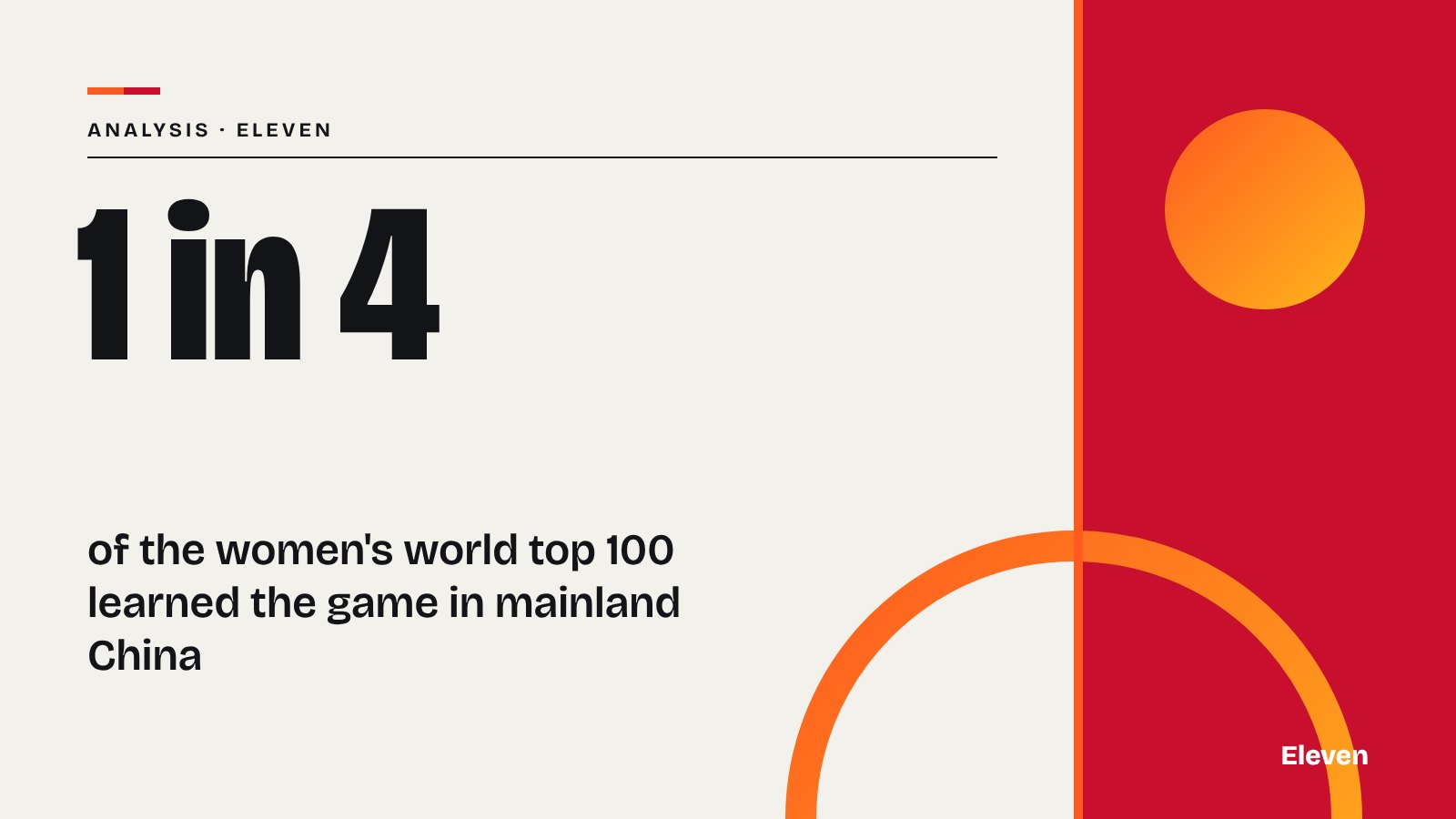
Across the women's game the pattern is starker. Eleven checked the birthplace and early career of every player in the ITTF world rankings of 26 October. Twenty-four of the women's top 100 were born in mainland China and took up the sport there: 13 who play for China and 11 who now represent someone else. Among the men the figure is 11, and only one of them plays for another country.
Near the top the gap widens. Nine of the women's top 20 learned the game in China, seven Chinese internationals plus Zhu Yuling and Han. Among the men there are four, all playing for China.
The 11 women playing for other countries range from Macau's Zhu, ranked 11th, to the Netherlands' Li Jie at No 100. Germany and Portugal have two each; France, Australia, Canada, Singapore and Monaco have one. Canada's Mo Zhang reached the final of the Americas Championships in Lima last week, losing 4-2 to Adriana Diaz. The only man is Slovakia's Wang Yang, born in Anhui in 1994 and ranked 88th.
Why players leave
The reasons players leave have changed little. China produces more good players than its national team can use. "In China, there are a lot of good players and it is very difficult for everyone to get a chance to play for the national team," Han told DT Next in 2017, when she was playing in India's Ultimate Table Tennis league. As a chopper, she has said, she was also in a system that kept few places for defenders.
Zeng Jian made the same calculation as a teenager. Born in Hunan and trained at Beijing's Shichahai Sports School, she played for Beijing in the Chinese Super League in 2013 and joined the Singapore association in late 2014. "If I'd stayed in China, I probably would have never had the chance to compete at the Olympics," she told China Daily at the Paris Games.
- 1970s1
- 1980s6
- 1990s3
- 2000s1
Eleven grouped the 11 women by year of birth as given in their Wikipedia, Olympics.com or federation profiles.
Source: Wikipedia; Olympics.com; Team Canada; South Australian Sport Hall of Fame
The sport's governing body once tried hard to slow the flow. At a meeting in Guangzhou in February 2008, the ITTF ruled that players over 21 who switched countries could no longer represent their new nation at the World Cup or World Championships, and that younger players would wait between three and seven years, depending on age. The aim, said Adham Sharara, then the ITTF president, was to "push each association to develop its own players", the South China Morning Post reported. The same report counted mainland-born players in 19 of the 48 teams at that year's World Championships. The Olympics, which the ITTF does not run, were unaffected. Today a player who registers with a new association at 21 or older waits nine years before playing a world title event for it.
The ages of the 11 fit that timeline. Seven were born before 1990, the oldest, Portugal's Fu Yu, in 1978. At least six had left China before the rules tightened; Li was already playing for the Netherlands at the 2008 Olympics. Those who have moved since went young. Jieni Shao left for Portugal at 16, and Zeng and Liu settled abroad as teenagers, early enough for the waiting periods to run out. Liu, born in 2002, is the only one of the 11 born this century.
Zhu is the exception. A former world No 1 with China, she left the national team in 2021 and, after a break, switched in 2024 to Macau, which has its own association. She has since won WTT titles in Cagliari, the US and Doha.
Medals, and what comes next
The arrivals have won medals for their adopted countries. Han was part of the German team that took Olympic silver in Rio in 2016, and Li won a world doubles bronze for the Netherlands in 2015. They have also caused resentment. "Through the easy access of the Chinese to the national teams, table tennis is being hollowed out from within," Jan Vlieg, a former Dutch national coach, told NOS in 2015 (translated from Dutch).
Eleven's count leaves out a group that may matter more in future: players born outside China to Chinese families. Germany's Dang Qiu, the world No 11, was born in Nürtingen to parents who trained in Jiangsu. Lily Zhang and Amy Wang of the US and Spain's Maria Xiao were also born abroad. Peter Hubner, a reporter for the German agency dpa, told China Daily in Paris that local fans had always complained about the use of Chinese immigrants. "But it will be easier for the second generation of Chinese players to be accepted," he said.
Fu is 47 and Han 43. When their generation stops playing, the women's top 100 will start to look like the men's: close to what Sharara wanted in 2008, nearly two decades after he asked for it.


