Sora Matsushima was two games up on Dang Qiu on Tuesday evening in Montpellier, and then he wasn't. The German took the third game 11-3 and the fourth 12-10. In the decider the 19-year-old dropped two points, and the world No 1 was through to the last 16 of WTT Champions Montpellier after 33 minutes. He leads a men's world top 10 whose average age has fallen by four years in a decade.
Qiu turns 30 on Thursday. When Matsushima was born in Kyoto in April 2007, Qiu was 10. On 5 October Matsushima became the youngest man to top the ITTF world ranking, at 19 years, five months and six days, taking the record from China's Lin Shidong, who reached No 1 in February 2025 aged 19 years and nine months.
The record came in a fast month. The week he went top, he won the China Smash in Beijing, coming from 3-2 down to beat Taiwan's Lin Yun-Ju 4-3 in the final. Earlier this year he had led Wang Chuqin 3-2 in the World Cup final in Macau before losing in seven games. Wang, now fifth, is missing Montpellier with an injury.
Counting the ages
- Men, November 201027.2
- Men, February 201628.7
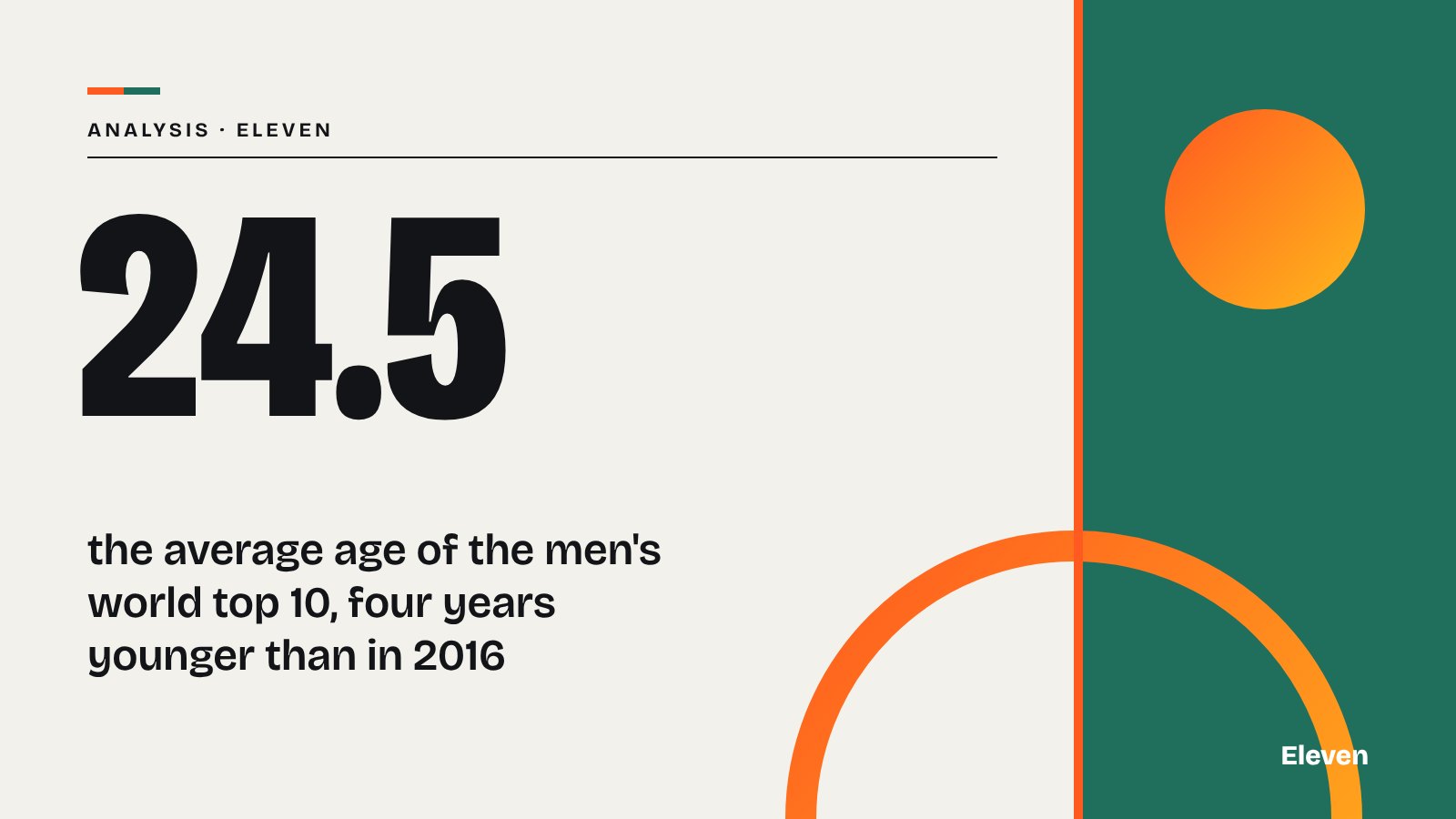
- Men, October 202624.5
- Women, November 201024.9
- Women, February 201625.8
- Women, October 202626.5
Eleven took the top 10 men and women in the ITTF world rankings of November 2010, February 2016 and 26 October 2026 and averaged each player's exact age on the first day of the ranking month (26 October for 2026), using dates of birth from WTT entry data and Wikipedia.
Source: ITTF world ranking, week 44; tischtennis.de monthly ranking reports (November 2010, February 2016); WTT; Wikipedia
Eleven worked out the average age of the world top 10 at three points: November 2010, February 2016 and the ranking of 26 October 2026. The men's top 10 now averages 24.5 years. In February 2016 it was 28.7, and in November 2010 27.2. The women's top 10 has gone the other way, from 24.9 in 2010 and 25.8 in 2016 to 26.5 today.
The men's list has turned over almost completely. Seven of the top 10 are 25 or younger, against two in 2016. Félix Lebrun, the world No 2, is 20, Lin Shidong is 21, and Tomokazu Harimoto and Alexis Lebrun are 23. The oldest, South Korea's Jang Woojin, is 31, and Brazil's Hugo Calderano, 30, is the only other man in the top 10 over 26. In February 2016 Vladimir Samsonov was in the top 10 at 39, with Timo Boll and Chuang Chih-yuan at 34.
Some of the newcomers came through together. In 2021 Matsushima and Félix Lebrun won the under-15 boys' doubles title at the World Youth Championships as a pair. Five years later they are first and second in the world. Japan now holds two of the top three men's places. In September 2016, when Samsonov was still in the men's top 10 at 40, the ITTF's under-15 and under-18 boys' lists were both headed by the 13-year-old Harimoto.
Who left, and why
Some of the change is about who left. In December 2024 Fan Zhendong, the Olympic champion, and Chen Meng withdrew from the world ranking rather than accept World Table Tennis fines for players who miss its events. Fan was 27. Ma Long, the Olympic champion in Rio and Tokyo, also left the ranking at the end of that month.
"I was never informed by officials before that I would be fined for withdrawing from the competition," Fan wrote on Weibo (translated by the South China Morning Post). WTT replied that the rules had been in place since it was founded. "The intent of these rules is to ensure that top-tier players are represented at key WTT events," it said in a statement.
- Men, November 20104
- Men, February 20162
- Men, October 20267
- Women, November 20106
- Women, February 20166
- Women, October 20264
Eleven counted the players in each top 10 who were 25 or younger on the ranking date, from the same rankings and dates of birth.
Source: ITTF world ranking, week 44; tischtennis.de; WTT; Wikipedia
The ranking itself now rewards that kind of attendance. Under rules introduced in 2021, it counts a player's best eight results, each valid for about a year, so a player who plays less soon slides down it. In February 2025 WTT relaxed the rules it had defended, dropping compulsory entry to its four Grand Smashes and allowing two exemptions a year from Champions events. Fan is not in today's top 100; he spent the 2025-26 season in the German Bundesliga with Saarbrücken.
The women's list
The women's list tells a different story. Miwa Harimoto is No 3 at 18, and China's Chen Yi and Kuai Man are 22. But four of the top 10 are 25 or younger, against six in both 2010 and 2016, and the middle of the list is in its late 20s. The world No 1, Wang Manyu, is 27. Wang Yidi and Chen Xingtong are 29, Japan's Hitomi Sato 28. Sun Yingsha is 25 and Hina Hayata 26.
In 2010 the women's top 10 had the younger edge. Liu Shiwen was No 2 at 19 and Ding Ning No 6 at 20, the next Chinese generation already pressing at the top. Today's oldest player is Germany's Sabine Winter, who is 34 and reached the top 10 for the first time in April, after winning bronze at the World Cup in Macau. Her best ranking had been 36th before she switched to an anti-topspin rubber on her backhand in November 2024.
"The top ten never even crossed my mind in my wildest dreams," Winter said in an interview published by the German Olympic Sports Confederation. She is the only woman over 30 in the top 10. In February 2016 the only one was another German, the defender Han Ying, at 32.
Matsushima's own view of his record was measured. "I'm simply happy, but it is a waypoint on the road to the Olympics," he said in comments carried by Butterfly's Takkyu Report (translated from Japanese). He is the first Japanese man to be world No 1 since Seiji Ono in 1980.
Ma Long was 21 when he first reached No 1, in January 2010, and went on to win two Olympic singles titles. Matsushima got there two years younger. He will be 21 at the Los Angeles Olympics in 2028.


