When Russia's players walk out in Chengdu on Sunday for the Mixed Team World Cup, they will do so under the flag and anthem of a country whose full-scale invasion of Ukraine is in its fifth year. It will be the first world team event Russia have been allowed to enter since table tennis banned them in 2022, and the decision by the International Table Tennis Federation (ITTF) that brings them back remains bitterly contested. "The symbols of the aggressor state cannot become part of a sporting celebration," Ukraine's sports minister, Matvii Bidnyi, said in July, when the International Olympic Committee (IOC) opened the way (translated from Ukrainian).
The objections reach well beyond Kyiv. Britain's culture secretary, Lisa Nandy, said she was "utterly appalled" by the IOC decision that opened the way, adding that "the Russian state should not be represented in international sport." The European Commissioner for Sport, Glenn Micallef, warned that "sport cannot become a back door for normalizing aggression". On Monday the European Commission went further, proposing sanctions that would stop Russian athletes competing under their flag at sports events in the European Union. "Sports events cannot be a forum for propaganda activities," said its president, Ursula von der Leyen.
Russia's players have wasted no time winning. On 18 October in Ljubljana, Elizabet Abraamian beat Germany's Annett Kaufmann 4-3 in the final of the European Championships and became the first woman to win the continent's singles title for Russia. The ceremony that followed had no Russian flag and no Russian anthem, because Slovenia, the host, had made their absence a condition of letting Russian players in; the European Table Tennis Union (ETTU) said it had been obliged to apply the host's terms. It was the high point so far of Russia's return, and a reminder of how much of that return still depends on other people's decisions.
Abraamian's own account of the final was about the people at home. "I kept remembering that the country stands behind me, that there are people behind me who believe, and I can't let them down," she said in comments released by the Russian federation's press service (translated from Russian). Kaufmann talked about her opponent. "We are very good friends. I like her a lot. And she plays incredibly good table tennis," she said, in remarks reported by the German news agency dpa (translated from German).
In Chengdu, Russia are one of 20 teams, led by Vladimir Sidorenko, the world No 19, and Abraamian, now No 25 on the world ranking. The city matters. In July 2022 the ITTF confirmed that Russia and Belarus would not be allowed to play the World Team Championships Finals in Chengdu that autumn. Four years on, the Russians return to the same city for the first world team event they have been allowed to enter since the ban. Between 2025 and July 2026 they could play only as neutral individuals, in singles, doubles and mixed doubles. Ukraine are not in the Chengdu field.
How table tennis got from one Chengdu to the other is a story of a governing body following the IOC's lead in both directions, of a federation that has always liked to see itself as a bridge between hostile states, and of a sport in which Russia, and the Soviet Union before it, was a serious force long before the war removed it. It is also an argument that has not been settled. The IOC and the ITTF say athletes should not pay for their government's actions. Ukraine, a growing list of European governments and athletes' groups reply that the war has not stopped, that the flag belongs to the state that is waging it, and that letting it back into the arena is a political act in itself.
The ban of 2022
Russia's full-scale invasion of Ukraine began on 24 February 2022. Four days later the IOC Executive Board recommended that international federations keep Russian and Belarusian athletes and officials out of their events, and on 1 March the ITTF's Executive Committee decided to follow the recommendation "with immediate effect". Its statement said that "until further notice, no Russian or Belarusian players and officials will be invited or allowed in events hosted by the ITTF Group, and no Russian or Belarusian national symbols, colours, flags, or anthems will be displayed." The ITTF's Athletes' Commission said it fully supported the decision.
Europe moved at the same time. On 3 March the ETTU's Executive Board ruled that Russian clubs could not take part in any European club competition for the rest of the 2021-22 season, which removed two Russian sides from the semi-finals of the men's Champions League; Borussia Düsseldorf took the title. Table Tennis England said that England would not field teams against Russia or Belarus. When the ITTF's Executive Committee met in Malmö in July, its task force reported that "the conditions that would allow overturning this decision had not been met", and Chengdu went ahead without them.
The ban covered international events only. In December 2022 the ITTF's task force noted that Russian and Belarusian players "were already competing professionally in several domestic leagues across Europe", and Russia's own league carried on at home.
A long Soviet shadow
The country that was banned had a deep table tennis history, though it came to the international game late. The sport fell out of official favour in the Soviet Union in the 1930s, when the state put its weight behind team and military sports, and the Soviets were among the founders of the ETTU in 1957, a year before the first European Championships in Budapest. They made up for lost time quickly. At the 1969 World Championships in Munich, the Soviet women, Zoja Rudnova, Svetlana Grinberg, Rita Pogosova and Laima Amelina, won the Corbillon Cup, the women's team title, beating Romania 3-0 in the final. Rudnova won four European titles at the 1970 championships in Moscow, and at the 1975 World Championships in Calcutta the mixed doubles final was an all-Soviet affair, won by Stanislav Gomozkov and Tatiana Ferdman against Sarkis Sarkhojan and Elmira Antonyan.
That team drew on the whole union. Sarkhojan was born in Batumi in Georgia, Valentina Popova, European singles champion in 1980 and 1984, in Sumgait in Azerbaijan; she later played for Slovakia. Fliura Bulatova won the European title in 1988, and the brothers Andrei and Dmitry Mazunov took a world doubles bronze in 1991, the year the Soviet Union came apart. One of the sport's best-known modern stories starts in the same world: Dimitrij Ovtcharov was born in Kyiv in 1988, the son of Mikhail Ovtcharov, a Soviet champion and international, and his family moved to Germany soon after.
After 1991 Russia's national teams were strong without dominating. The women won the European team title in Birmingham in 1994, and Alexey Smirnov reached the world top 20 in 2007. The real power was in the clubs. Fakel Gazprom Orenburg, backed by the gas giant whose name it carried and coached by Valery Salabaev, won the men's Champions League five times between 2012 and 2019, with Ovtcharov, Belarus's Vladimir Samsonov and Japan's Jun Mizutani among its players. Ovtcharov played for Orenburg from 2010 until 2022. A younger generation was coming through as the war began: Lev Katsman and Maksim Grebnev won the European men's doubles in Warsaw in 2021, at the championships postponed from 2020, and Abraamian won the European under-19 title the same summer.
The ITTF, meanwhile, has always told a story about itself in which politics is something table tennis gets around. Ivor Montagu, the Englishman who led it from its foundation in 1926 until 1967, was a communist who later received the Lenin Peace Prize; under him the federation recognised the People's Republic of China in 1953, and in the 1950s it expelled apartheid South Africa. In April 1971, after the World Championships in Nagoya, the American team was invited to China, the visit that became known as ping-pong diplomacy. When the ITTF opened the door to Russian players again in 2023, it reached for exactly that history.
The neutral years
On 30 March 2023, two days after new IOC guidance, the ITTF's Executive Board said it supported admitting players with Russian or Belarusian passports "under strict conditions of neutrality". It recalled the 50th anniversary of ping-pong diplomacy, said the ITTF was "acutely aware of the potential dialogues sport can create" and added that "Table Tennis has a long history of bringing people together even when political ties have been tenuous." In the same statement it repeated that it "unequivocally condemns the war in Ukraine". The IOC's conditions ruled out team events, athletes contracted to the military or security services and anyone who actively supported the war, and no Russian flag, anthem or government official was allowed. At its general meeting in Bangkok that August, the ITTF created a formal category of neutral athlete.
The door was open in principle, but for two years almost nobody came through it. Eleven's results database has no singles match by a Russian player at a WTT or ITTF senior event in 2023 or 2024. The March 2023 statement was only the first step: the ITTF said it would review the IOC's recommended conditions and "consult with other IFs to create official guidelines that spell out explicit conditions of participation for players and support personnel with a Russian or Belarusian passport". Each player then had to be vetted against the IOC's conditions, and the exclusion of athletes contracted to the military or security services weighs heavily in Russian sport, where army and interior-ministry clubs such as CSKA and Dynamo pay many elite athletes.
Time was against them too. World ranking points last a year, so by 2023 Russia's players had lost the rankings that would have put them straight into WTT draws. The first two back, Grebnev and Abraamian, played under neutral status at WTT Contender Tunis in April 2025. When most of the others followed, at WTT Contender Almaty in September 2025, they started in qualifying, and Sidorenko won his first title of the return at a WTT Feeder event in Istanbul a week later. At the Paris Olympics in 2024, 32 Individual Neutral Athletes from Russia and Belarus competed in 10 sports; table tennis was not one of them. The IOC had suspended the Russian Olympic Committee in October 2023, after it took in regional sports bodies from occupied Ukrainian territory.
Europe was a separate fight. The ETTU kept its own 2022 ban, and the Russian federation took it to the Court of Arbitration for Sport. In June 2024 the court annulled the ETTU's suspension of Russian players and the disqualification of Russian clubs from the Champions League, while leaving the ban on national symbols in place, according to the federation's lawyers. When the full reasoning was published in October 2025, the lawyers said the court had found the measures disproportionate and discriminatory, partly because the ETTU had not considered letting Russians play under a neutral flag. Ukraine's sports minister, Matvii Bidnyi, objected. "They are constantly looking for ways to challenge something, to slip through somewhere," he said (translated from Ukrainian).
For the players, the return was personal. "For four years I couldn't play in international tournaments. You know, we were suspended," Sidorenko told Sport24 after reaching the final of WTT United States Smash in July 2026 (translated from Russian). "When I slept, I dreamed I was playing at big events and winning. But I'd wake up and realise it was impossible. And here I am." In Los Angeles he came from 3-1 down to beat Sweden's Truls Moregard 4-3 in the semi-final before losing the final 4-2 to Japan's Sora Matsushima, and became the first Russian in the world top 20 since Smirnov in 2007.
Russian and Ukrainian players have already met across the table. Eleven counted seven matches between Russian and Ukrainian players at WTT events since the return, five in singles and two in mixed doubles. The most striking came in qualifying at Singapore Smash on 19 February 2026, five days before the fourth anniversary of the invasion, when Ukraine's Margaryta Pesotska beat Abraamian 3-2, taking the deciding game 12-10.
The flag comes back
The neutral arrangement lasted 15 months. On 18 June 2026 the ITTF's Executive Board approved the unrestricted return of Belarusian players from 28 July, with their flag and anthem. On 7 July the IOC's Executive Board provisionally lifted its suspension of the Russian Olympic Committee and said its recommendations to international federations no longer applied, after the Russian Olympic Committee gave assurances that it does not conduct activities in the occupied territories. "We don't condone any wars, including this one," said Kirsty Coventry, the IOC president. "But I don't believe athletes should pay the price." The IOC said it would decide on the Russian flag and anthem for the Olympic Games "at the appropriate time", which leaves Los Angeles 2028 open.
The timing drew particular anger. The IOC announced its decision the day after a Russian missile and drone attack on Kyiv killed 22 people, the Associated Press reported. Global Athlete and FairSport, two athlete-led campaign groups, said in a joint statement that the decision "represents a fundamental departure from the principles of Olympism". Zaineb Al-Samarai, the president of Norway's Olympic committee, said that "the current situation does not warrant allowing Russian athletes to return to international competition". Ukraine's skeleton racer Vladyslav Heraskevych told Reuters it was "absolutely shameful", and Zhan Beleniuk, an Olympic wrestling champion and now an MP, said: "Such decisions are shameful. They cast a shadow over the entire Olympic movement."
The ITTF acted six days later. Its Executive Board decided that "athletes holding a Russian passport shall be reinstated and permitted to participate in ITTF table tennis and Para table tennis events, under the ordinary conditions applicable to all athletes, with effect from 28 July 2026", in team as well as individual events. The decision is subject to anti-doping testing, visas, sanctions and the law of host countries, and the ITTF said in the same announcement that it "reaffirms its solidarity with the Ukrainian table tennis community." Russia's junior players had already been allowed their flag and anthem in April.
Mikhail Degtyarev, Russia's sports minister, had called the IOC's move "a green light for international federations to reinstate all our athletes", and after the ITTF's decision he wrote on Telegram that "the combination of active sports diplomacy and legal work delivers results" (translated from Russian). Alexander Babakov, the president of the Russian Table Tennis Federation, credited the federation's work and said Russia should now compete for medals, TASS reported. In Kyiv, Bidnyi asked federations to keep their restrictions. Ukraine's National Olympic Committee called the IOC's decision "premature, unfounded and taken without regard to objective circumstances, which remain unchanged" (translated from Ukrainian).
Other federations have mostly kept playing while saying what they think. Before Europe Smash in Malmö in August, where Russians competed under their own flag, the chairman of the Swedish Table Tennis Association, Tomas Eriksson, told SVT: "It is unfortunate. Nothing has changed in substance since the outbreak of war in February 2022" (translated from Swedish). Sweden did not withdraw, and Eriksson said that every player was free to hold their own view. On the table, the first meeting between a Swede and a Russian under the restored flag went the home side's way: Anton Källberg beat Sidorenko 3-0 in Malmö on 11 August. The first event with the Russian flag was WTT Champions Yokohama in early August. The Slovenian restrictions in Ljubljana in October were the exception; in Nevşehir in Turkey this month, Russia's under-13 team, playing under national symbols, beat Ukraine 3-0 in the final of the European mixed team championship.
Elsewhere in Europe the resistance is hardening, mostly through governments rather than sports bodies. Norway, Sweden and Poland have refused visas to Russian athletes, Reuters reported on Monday, and Romania kept the Russian flag and anthem out of the Winter European Youth Olympic Festival in February, a decision Russia has taken to the Court of Arbitration for Sport. The ITTF's own July decision leaves visas and the law of each host country to the host, so the same could happen to a table tennis event. "Europe is divided on this matter," said Spyros Capralos, the president of the European Olympic Committees.
Ukraine's players through the war
For Ukraine's players the war was never a question of eligibility. In its first days the Ukrainian Table Tennis Federation told the ETTU that the most urgent help it needed was from clubs in neighbouring countries that could take in refugee athletes and their families, and the European union put out that call in March 2022. Four of the national squad, Tetyana Bilenko, Ganna Gaponova, Margaryta Pesotska and Yaroslav Zhmudenko, were traced in Europe and flown to WTT Star Contender Doha that month, with the ITTF arranging their flights and visas. For a week the table was a refuge. "Our minds were just focused on the matches and we didn't think about the war," Bilenko said in Doha.
"Many had to flee from the country and among them, there are a lot of table tennis players," Galia Dvorak of the ITTF Foundation said in May 2022, when the foundation was paying for Ukrainian players to travel to WTT events and Ukraine's Para players were training in Prievidza, Slovakia. That summer the ETTU gave the whole Ukrainian team free hospitality at the European Youth Championships and launched a crowdfunding appeal with a target of €100,000 to keep Ukrainian players in its events. Some players left for good: Roman Odintsov settled in Sandefjord in Norway, where he and his son joined the local club, STIF Sandefjord.
At home, the halls were hit. At the end of March 2022 the federation reported that the Khimik hall in Chernihiv, built for table tennis and used for national youth and senior tournaments, was unfit for use after a missile left a 10-metre crater on the sports ground beside it. A month later it said a specialist table tennis hall at Kherson's college of physical culture, one of the country's main training venues, had been damaged in the fighting in the region. "Once again the occupiers are fighting against sports infrastructure," the federation wrote (translated from Ukrainian).
The results came anyway. At the 2022 World Para Championships in Granada, Lev Kats and Ivan Mai won Ukraine's first gold, in class 18 men's doubles, at a championships the ITTF Foundation and the IOC's solidarity fund had helped them reach. In May 2024 Zhmudenko won his place at the Paris Olympics at the European qualifier in Sarajevo. "I dedicate this win to my people of Ukraine," he said. He, Pesotska and Solomiya Brateyko played in Paris, where Pesotska won a round before losing to Romania's Bernadette Szőcs, and at the Paralympics a few weeks later Viktor Didukh won gold, beating China's Zhao Shuai 3-2 in the final, three years after losing the Tokyo final to him.
In May this year Ukraine's women reached the quarter-finals of the World Team Championships in London, beating England 3-1 in front of the home crowd and the United States 3-2 before losing 3-0 to Japan. Their preparation still runs to the rhythm of the air-raid sirens. "It's an alarm and a rocket attack, so we go downstairs. In the winter, we don't have light, we don't have anything," Bilenko, 42, told the Sports Gazette during the championships. The youngest of the squad, 19-year-old Veronika Matiunina, had moved to Germany while her team-mates stayed in Ukraine. "I hope the war will finish soon so that we can have preparation camps all together, with more team spirit," she said.
Ukraine has also set its own terms for sharing a hall with Russians. In March 2023 the government said its national teams would boycott events with Russian and Belarusian athletes; in July that year it let them compete against neutrals. In December 2025 the sports ministry changed the order again. The ban on events where Russians compete under their own symbols stays, but a commission that includes the security services can make exceptions case by case, and the order applies only to events to which the state sends a team. "This does not mean we will go everywhere Russians are present," Bidnyi said. "But Ukraine cannot exclude itself from the international sporting agenda" (translated from Ukrainian).
Ukrainian players have kept playing on the WTT circuit since the Russian flag came back. In Eleven's results, Ukrainian and Russian players have both played at seven WTT events since 28 July, from Champions Yokohama to WTT Contender Istanbul, but they have not met. All seven matches between them came before the flag returned, the last two on 4 July at a WTT Feeder event in Istanbul. With only a few Ukrainians and Russians in each draw, that may be no more than chance; the first meeting under the Russian flag is still to come.
What the numbers show
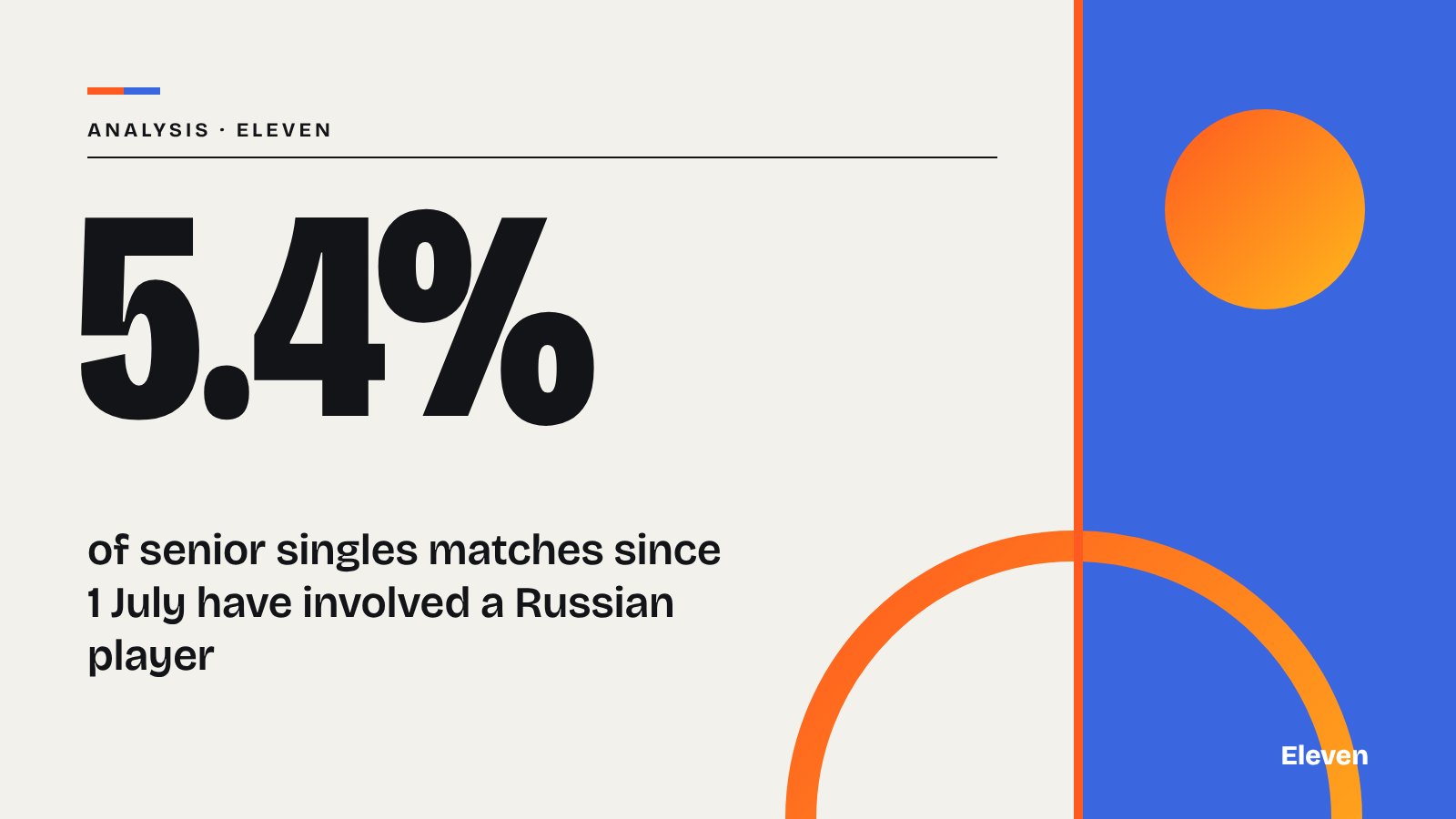
Eleven's results show how quickly Russia has climbed back into the circuit. Since 1 July, more than one in 20 senior singles matches at WTT and ITTF events has involved a Russian player. In the 15 months of neutral status, Russians played at 18 WTT events, none of them a WTT Champions event, the 32-player tier for the world's best; since the flag returned they have played at 12, four of them Champions events, from Yokohama to Montpellier. The fields are harder: Russians won 63% of their singles matches as neutrals and 53% since 28 July, in stronger fields (Eleven counted each Russian player's singles matches at WTT and ITTF events in the two periods). Artemenko and Grebnev won the men's doubles at WTT Contender Istanbul this month.
- Jul-Dec 20216.2%
- Jan-Jun 20220.7%
- Jul-Dec 20220%
- Jan-Jun 20230%
- Jul-Dec 20230%
- Jan-Jun 20240%
- Jul-Dec 20240%
- Jan-Jun 20250.1%
- Jul-Dec 20252.4%
- Jan-Jun 20263.3%
- Jul-23 Nov 20265.4%
Eleven counted every completed men's and women's senior singles match with a recorded score at WTT and ITTF events in its results database, from July 2021 (when the database begins) to 23 November 2026, and the share with at least one player who now represents Russia. The database covers fewer events in 2021 and 2022 than later, so the early figures are a guide only. The 2022 matches were all played in January, before the invasion.
Source: WTT results
The ranking is thinner than the noise. Four Russians are in this week's world top 100: Sidorenko, Evgeny Tikhonov (73rd) and Nikita Artemenko (77th) among the men and Abraamian among the women. That is a respectable squad for a team event of best-of-three matches, where a seventh-ranked man can lose to a 70th, but it is a long way from Orenburg's years at the top of Europe or the Soviet women of Munich. Abraamian is the only Russian woman in the top 100, and the next, Vlada Voronina, is 113th.
Chengdu
The Mixed Team World Cup starts on 29 November and the final is on 6 December. China have won all three editions and are favourites again. Eleven's event page has the squads and will have the groups and scores. Whatever happens on the table, the arrangement that brings Russia to Chengdu is the one the ITTF has followed since 2022: it moved when the IOC moved, in both directions, and it says it supports Ukraine at every step.
The arguments on each side have not changed since February 2022. Coventry says athletes should not pay the price for their government. Ukraine's minister and Olympic committee say that the war goes on and the flag is the state's, and the European Union may yet write that view into sanctions before Christmas. In Ljubljana, Abraamian stood on the top step with neither flag nor anthem. In Chengdu the flag will be back beside her name, and the question that table tennis has passed back to the IOC, whether the same will be true in Los Angeles, will still be waiting when she leaves.